
M Dittrich
2025/06/06
5 / 5
The book is very well written
Book guide and evaluation
Ketan Mulmuley
1 reviews
Published
pages
views
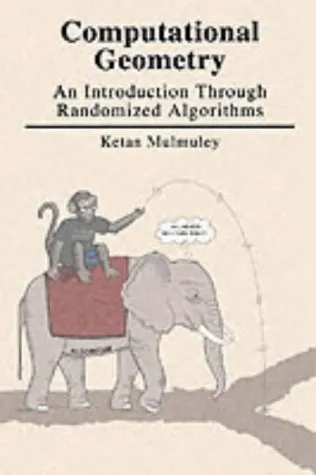
Introduction to "Computational Geometry: An Introduction Through Randomized Algorithms" "Computational Geometry: An Introduction Through Randomized Algorithms" is a distinctive and influential book authored by Ketan Mulmuley. It provides a fresh perspective on comp
Before you read
"Computational Geometry: An Introduction Through Randomized Algorithms" is a distinctive and influential book authored by Ketan Mulmuley. It provides a fresh perspective on computational geometry by focusing on randomized algorithms, a modern and powerful approach to solving geometric problems efficiently. The work stands out as a pivotal contribution to both theoretical computer science and practical applications, offering readers insights that seamlessly blend rigorous mathematical concepts with innovative computational techniques.
This book delves into the field of computational geometry, which is concerned with designing and analyzing algorithms to solve geometric problems. Unlike many traditional texts that use deterministic approaches to tackle such problems, this book emphasizes the utility of randomized algorithms. Randomization introduces elements of probability that often streamline solutions and improve efficiency, making this approach both practical and elegant.
The content is presented in an intuitive yet formal manner, ensuring accessibility for students and professionals alike. The topics covered span fundamental algorithms and data structures, such as convex hulls, Voronoi diagrams, and point location, to advanced geometric techniques incorporating randomization. The mathematical underpinnings—probability theory, combinatorics, and complexity analysis—are interwoven seamlessly, equipping readers with the knowledge necessary to grasp both the theory and implementation of these methods.
By eschewing deterministic dogma, the book challenges existing norms and demonstrates how randomness can simplify traditionally complex computational tasks. Each chapter is carefully structured, with numerous examples and exercises, making it an excellent companion for academics and practitioners. Whether you’re designing real-world applications in robotics or conducting research in theoretical computer science, this book will undoubtedly deepen your understanding of computational geometry.
"Randomization in algorithms is not merely a tool; it is a paradigm change, reshaping the very foundations of computational problem-solving."
"In computational geometry, where precision and efficiency are paramount, randomization elegantly bridges the gap between theoretical complexity and practical feasibility."
"Geometry is more than structure; it is a language, and randomized algorithms provide an intuitive syntax for solving its riddles."
"Computational Geometry: An Introduction Through Randomized Algorithms" holds a special place in the canon of computer science literature. By emphasizing randomization, it addresses the increasing demand for scalable and efficient algorithms in a world dominated by massive datasets and complex geometric applications. Industries such as computer graphics, robotics, geographic information systems (GIS), and artificial intelligence rely heavily on computational geometry to solve practical problems, ranging from collision detection to spatial data analysis.
The book’s groundbreaking approach inspires readers to think outside the conventional deterministic framework, fostering creativity in problem-solving. It is especially relevant in today’s era of big data and machine learning, where probabilistic methods and randomized algorithms have become indispensable. Whether you are a student, researcher, or software engineer, this text equips you with the tools and mindset needed to tackle some of the most challenging problems in computational geometry.
Furthermore, the book’s clarity and structure make complex concepts accessible to a broad audience. It not only serves as a foundational text for academics but also provides a resource for professionals to sharpen their skills in algorithm design and analysis. The emphasis on practical applications ensures that the knowledge gained is directly relevant to real-world challenges, making this book as much about learning as it is about applying computational geometry effectively.
Your question is answered in the context of this title and author. Each answer uses 2 points.
1 reviews, 5.0 average out of 5
2025/06/06
5 / 5
The book is very well written
Sign in to publish a review.
Ask a focused question and learn from the community.
Related references that continue this learning path.

V Kishore Ayyadevara,Yeshwanth Reddy