
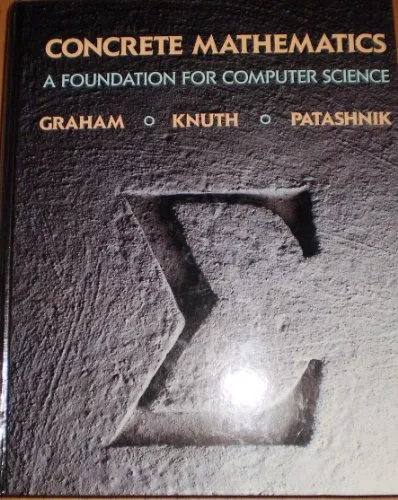
Concrete Mathematics: A Foundation for Computer Science
Ronald L. Graham,Donald Knuth,Oren Patashnik
1988
View book

Book guide and evaluation
Alexei V. Samsonovich; Rebecca F. Goldin; Giorgio A. Ascoli
0 reviews
Published
pages
views
Complexitypp.NA—NA complex systems theory, cognitive modeling Complexitypp.NA—NA explores the structure, behavior, and implications of complex systems with academic precision. Analytical Summary Complexitypp.NA—NA is an in-depth exploration into the nature, dynamics, and th
Before you read
Complexitypp.NA—NA is an in-depth exploration into the nature, dynamics, and theories underlying complex systems, authored by Alexei V. Samsonovich, Rebecca F. Goldin, and Giorgio A. Ascoli. Serving as both a scholarly reference and a conceptual roadmap, the book intricately examines how multifaceted systems emerge, evolve, and interact in diverse contexts—ranging from neuroscience to mathematics and computational modeling.
The text integrates foundations from mathematics, cognitive science, and engineering, offering a unified lens to study complex behaviors. In this synthesis, the authors delve into mechanisms that give rise to patterns, self-organization, nonlinear dynamics, and adaptive processes in natural and artificial systems. Their approach also accentuates the importance of inter-disciplinary dialogue when tackling conceptual and practical challenges in modeling complex phenomena.
While Information unavailable for certain publication specifics, the intellectual footprint of Complexitypp.NA—NA resonates with academic communities interested in pushing the boundaries of system-level understanding. Through rigorously structured arguments, it invites readers to consider both theoretical models and empirical data as complementary tools in advancing research.
Readers will find that Complexitypp.NA—NA does more than define complexity—it dissects it, contextualizes it, and positions it within a broader framework of knowledge.
It emphasizes the centrality of modeling in comprehending complex phenomena, linking mathematical abstractions to experiential realities.
The work underscores how cross-pollination among disciplines fosters innovation in addressing complexity, particularly in cognitive modeling and systems analysis.
The authors balance deep theoretical insight with accessible language for academics, graduate students, and professionals committed to understanding complexity at a structural and functional level.
Each chapter builds upon a layered conceptual architecture, enabling progressive engagement—from fundamental definitions to advanced applications.
"Understanding complexity requires embracing uncertainty while seeking underlying structure." Unknown
"Interdisciplinary thinking transforms isolated insights into holistic comprehension." Unknown
"Models are not reality; they are languages through which reality becomes intelligible." Unknown
Complexitypp.NA—NA stands out because it not only charts the landscape of complex systems theory but also embeds cognitive modeling directly into that terrain.
In doing so, it creates a vivid, applicable framework for studying phenomena that do not conform to reductionist analysis. For researchers working at the intersection of cognitive science and system theory, this is particularly valuable.
The book's methodological pluralism encourages adaptation and dialogue, equipping professionals to approach complexity with both computational rigor and philosophical openness. These qualities make it essential reading for those who seek to contribute to, rather than merely observe, the evolution of complex systems research.
In its depth, clarity, and ambition, Complexitypp.NA—NA is an invitation—both to read and to join an ongoing conversation about the structures and patterns that animate our world.
Whether you are an academic, a professional researcher, or a dedicated student of complex systems theory and cognitive modeling, this work offers tools, perspectives, and questions that are directly relevant to your field. Its interdisciplinary design ensures that no single perspective dominates; instead, readers are encouraged to synthesize knowledge across domains.
Now is the time to engage with Complexitypp.NA—NA: read it closely, share it with peers, and enter the dialogue it has so thoughtfully begun.
Your question is answered in the context of this title and author. Each answer uses 2 points.
0 reviews, 5.0 average out of 5
Sign in to publish a review.
Ask a focused question and learn from the community.
Related references that continue this learning path.
Ronald L. Graham,Donald Knuth,Oren Patashnik

Thomas A. Garrity,Lori Pedersen