
Book guide and evaluation
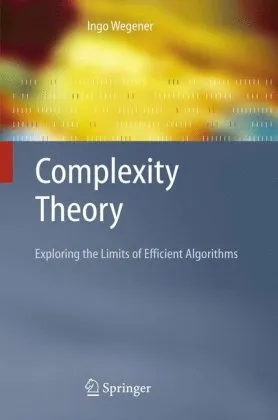
Complexity Theory: Exploring the Limits of Efficient Algorithms
Ingo Wegener
English
Beginner
Software Engineering
4.8 / 5
0 reviews
2005
Published
306
pages
183
views
Introduction to Complexity Theory: Exploring the Limits of Efficient Algorithms Welcome to a deep dive into the fascinating world of computational complexity! "Complexity Theory: Exploring the Limits of Efficient Algorithms" is not just a book; it is an intellectual explor
Before you read
What will you get from this book?
Introduction to Complexity Theory: Exploring the Limits of Efficient Algorithms
Welcome to a deep dive into the fascinating world of computational complexity! "Complexity Theory: Exploring the Limits of Efficient Algorithms" is not just a book; it is an intellectual exploration into one of the most thought-provoking fields in computer science. Written by Ingo Wegener, this book serves as both a comprehensive guide for students and a thought-provoking companion for researchers and professionals.
Complexity theory addresses fundamental questions such as: What makes certain computational problems inherently hard? What are the theoretical boundaries of what computers can achieve efficiently? With a core focus on the limits of algorithmic efficiency, this book is a valuable resource for anyone eager to understand the intricacies of mathematical rigor and computer science. Whether you're venturing into the subject for the first time or seeking a deeper understanding, this text has something meaningful to offer.
Detailed Summary of the Book
At its essence, this book systematically explores the theoretical framework surrounding computational problems, highlighting both their solvability and the resources required to solve them. The text begins by setting the foundation with basic concepts such as Turing machines, decision problems, and the distinction between deterministic and nondeterministic computation.
As the chapters progress, the book delves into the primary complexity classes – P, NP, co-NP, PSPACE, and more. It examines key concepts like reductions, completeness, and hierarchy theorems to demonstrate how problems are classified based on their computational difficulty. Of course, no discussion of complexity theory would be complete without addressing the famous P vs. NP problem. Here, Ingo Wegener provides a clear and accessible account of why this problem remains one of the most profound open questions in science.
Beyond these foundational topics, the book ventures into advanced areas such as approximate algorithms, randomized computation, and the limitations of parallelism. Special attention is given to practical examples and real-world applications, making the theories and concepts highly relatable.
Key Takeaways
- An in-depth understanding of computational complexity, including concepts like NP-completeness and space complexity.
- A solid framework for analyzing and classifying computational problems based on their resource requirements.
- Insights into advanced topics such as approximation algorithms, randomization, and interactive proofs.
- A critical awareness of the limitations of computational models and the boundaries of algorithmic efficiency.
- Clarity on why foundational problems like P vs. NP are central to both theoretical and applied computing.
Famous Quotes from the Book
"Complexity theory holds the answers to the most profound question in computing – how efficiently can we solve problems, and where do the limits lie?"
"The beauty of computational complexity lies in its dual nature: it challenges us mathematically while profoundly impacting the real world."
Why This Book Matters
The importance of "Complexity Theory: Exploring the Limits of Efficient Algorithms" cannot be overstated. In an era where computational power drives innovation across nearly all fields, understanding the principles of complexity theory is more critical than ever. This book bridges the gap between abstract theory and practical applications, enabling readers to appreciate not only the elegance of the mathematics behind computation but also its relevance to solving real-world problems.
Complexity theory is a cornerstone of computer science, influencing areas as diverse as cryptography, machine learning, and operations research. With its clear, structured approach, this book is indispensable for students aiming to build strong foundations, researchers delving into cutting-edge problems, and professionals seeking to understand the computational trade-offs in their domain.
Ultimately, this book serves as a call to curiosity, inviting readers to ponder the essence of computation itself and to question the very limits of human ingenuity in solving problems. Its clarity, rigor, and insight make it a timeless contribution to the field.
Ask this book
Your question is answered in the context of this title and author. Each answer uses 2 points.
Sign in to ask the book assistant.
Reader reviews
0 reviews, 4.8 average out of 5
No reviews yet
If you have read this book, help the next reader with your experience.
Write a review
Sign in to publish a review.
Reader questions and answers
Ask a focused question and learn from the community.
Sign in to ask or answer a question.
No questions yet
Be the first to ask a clear, useful question.
What to read next
Related references that continue this learning path.


Modern Computer Vision with PyTorch: A Practical Roadmap From Deep Learning Fundamentals to Advanced Applications and Generative AI, 2nd Edition
V Kishore Ayyadevara,Yeshwanth Reddy
2023
View book