

Creativity and Innovation Among Science and Art: A Discussion of the Two Cultures
Christine Charyton (eds.)
2015
View book
Book guide and evaluation
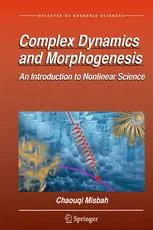
Chaouqi Misbah (auth.)
0 reviews
Published
pages
views
Introduction to Complex Dynamics and Morphogenesis: An Introduction to Nonlinear Science Complex Dynamics and Morphogenesis: An Introduction to Nonlinear Science is a foundational guide that takes readers deep into the intricate world of nonlinear systems, their inhere
Before you read
Complex Dynamics and Morphogenesis: An Introduction to Nonlinear Science is a foundational guide that takes readers deep into the intricate world of nonlinear systems, their inherent complexities, and the mesmerizing patterns they generate in nature. This book bridges the gap between theoretical physics, mathematics, and biological phenomena, offering a comprehensive exploration of how simplicity transforms into complexity. Written in an accessible yet thorough manner, it equips both new learners and seasoned researchers with the tools to navigate this fascinating domain effectively.
The book covers an exciting array of topics, from fundamental aspects of nonlinear dynamics and chaos theory to the role of mathematical models in understanding morphogenesis—how patterns and forms arise in nature. It introduces concepts like bifurcation theory, self-organization, and complex adaptive systems while touching on real-world examples like the structure of living organisms, fluid flows, chemical oscillations, and even larger-scale cosmic phenomena.
Broken into concise, logically structured chapters, this book begins by laying the groundwork for understanding nonlinear systems in general terms. The initial sections provide an introduction to the basic principles of nonlinear science, including dynamic systems, stability, and the differences between linearly predictable behaviors and those governed by chaos. As readers advance, they encounter deeper insights into bifurcation theory—a means of understanding how slight changes in system parameters can lead to radically different outcomes.
The core of the book delves into pattern formation and morphogenesis, utilizing mathematical models to explain how complex forms emerge from seemingly uniform conditions. Readers will explore Turing patterns, reaction-diffusion systems, and the principles of self-organization in nature. This knowledge is tied to real-world phenomena, highlighting how these frameworks describe the formation of animal coat patterns, fluid dynamics, and even the organization of cities.
In its later chapters, the book takes a step further to discuss chaos theory, strange attractors, and fractals, illuminating the bridge between deterministic systems and disorderly outcomes. The book exemplifies how chaos, rather than being synonymous with randomness, is often governed by strict underlying rules. Additionally, it offers practical discussions on computational models and simulation techniques, ensuring readers can apply the concepts they learn.
This text masterfully intertwines theory and practical insights, providing numerous examples, diagrams, and exercises to solidify understanding. Each chapter concludes with thought-provoking problems designed to challenge the reader’s grasp of the material.
"What appears to be chaos at first glance is often governed by an inherent order waiting to be uncovered."
"Nature doesn’t just build patterns; it builds rules by which patterns persist, evolve, and adapt."
"The simplicity of nonlinearity is deceptive—within it lies a gateway to unbounded complexity."
Complex Dynamics and Morphogenesis is not merely an academic textbook; it is a profound exploration of how complexity emerges from simplicity. By providing a fresh perspective on how nonlinear systems behave in nature, the book plays a crucial role in expanding our understanding of a multitude of fields, including physics, biology, chemistry, and even social sciences.
This book matters because it offers a toolbox for understanding and predicting phenomena in an inherently unpredictable world. It empowers researchers, scholars, and enthusiasts to tackle interdisciplinary questions, making it an essential read for anyone interested in unlocking the secrets of the natural world. Furthermore, its applications extend far beyond the scientific realm, influencing technology, medicine, and environmental studies.
Ultimately, this book stands as a tribute to the elegance of nonlinear science—reminding us that the rules of the universe, though intricate, are beautifully logical and deeply connected.
Your question is answered in the context of this title and author. Each answer uses 2 points.
0 reviews, 4.5 average out of 5
Sign in to publish a review.
Ask a focused question and learn from the community.
Related references that continue this learning path.
Christine Charyton (eds.)

Daniel Andler (auth.),Mauricio Suárez,Mauro Dorato,Miklós Rédei (eds.)