A Comprehensive Introduction to Differential Geometry, Vol. 1, 3rd Edition
Michael Spivak
1999
View book
Book guide and evaluation
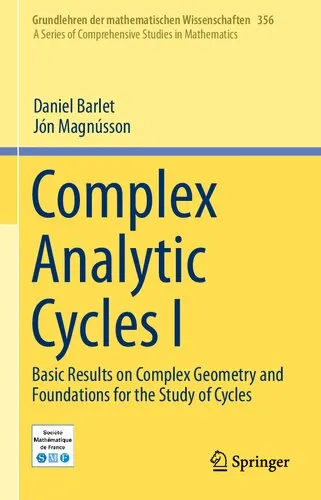
Daniel Barlet,Jón Magnússon
0 reviews
Published
pages
views
Introduction to "Complex Analytic Cycles I" "Complex Analytic Cycles I: Basic Results on Complex Geometry and Foundations for the Study of Cycles", written by Daniel Barlet and Jón Magnússon, is a profound exploration of the intricate world of complex analytic geometry. Th
Before you read
"Complex Analytic Cycles I: Basic Results on Complex Geometry and Foundations for the Study of Cycles", written by Daniel Barlet and Jón Magnússon, is a profound exploration of the intricate world of complex analytic geometry. This book marks the first volume in a comprehensive series aimed at delving deeply into the theory of complex analytic cycles—a cornerstone of advanced mathematical analysis and geometry. It provides a foundational framework necessary for researchers and practitioners engaging in this fascinating area of mathematics.
Enriched with rigorous proofs, clear explanations, and an overarching perspective of the field, the book bridges the gap between deep mathematical theory and practical application. Combining geometric intuition with formal mathematical rigor, it emphasizes not only the structural aspects but also the dynamic interplay between geometry, analysis, and topology in the realm of complex analytic spaces. As part of Springer’s prestigious Grundlehren der mathematischen Wissenschaften series, this volume sets a high standard for anyone looking to explore the frontiers of complex analysis.
The central subject of the book revolves around the concept of cycles in the context of complex geometry. A cycle, in the analytic sense, is a formal linear combination of complex subvarieties of a given analytic space. These objects are pivotal in understanding and describing the geometry, topology, and analytic properties of complex spaces.
The book begins with a rigorous treatment of the fundamental underpinnings necessary to comprehend analytic cycles, from basic results in complex geometry to advanced tools, such as sheaf theory and cohomology. With an emphasis on internal consistency, the authors meticulously build the theoretical constructs required for studying cycles. Readers will appreciate the clarity in presenting a balanced fusion of classical and modern developments in the field.
Key topics covered in the book include:
Throughout the book, Barlet and Magnússon emphasize precise definitions and a logical flow of concepts, making it accessible to advanced students while remaining invaluable to seasoned researchers.
Readers of this book will acquire:
More importantly, the book instills a deeper appreciation for the unifying nature of complex analytic geometry.
“Complex analytic cycles are not merely algebraic constructs; they are the living scaffolding of geometry and analysis, revealing the intricate dance between space, structure, and function.”
“Geometry illuminated by analysis does not merely describe space—it defines a language for conceptualizing the infinite.”
"Complex Analytic Cycles I" is an essential resource for anyone engaged in advanced studies in mathematics, particularly in the fields of complex geometry, analysis, and algebraic geometry. Its importance stems from several factors:
In essence, this book bridges the gap between learning and research, fostering a deeper understanding of the subject while inspiring new directions in inquiry.
Whether you are a graduate student venturing into the realm of analytic geometry for the first time or an expert looking for a robust reference, "Complex Analytic Cycles I" is a timeless addition to your library.
Your question is answered in the context of this title and author. Each answer uses 2 points.
0 reviews, 4.5 average out of 5
Sign in to publish a review.
Ask a focused question and learn from the community.
Related references that continue this learning path.
Michael Spivak
Svetlana Cojocaru,Svetlana Cojocaru,Gerhard Pfister,Victor Ufnarovski