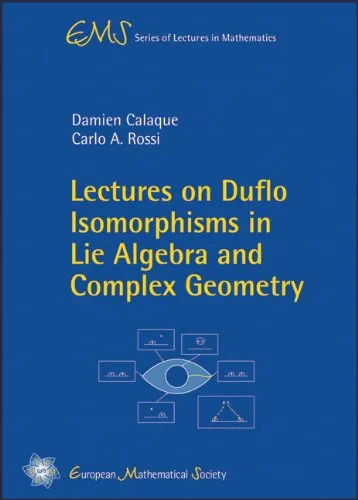
Lectures on Duflo Isomorphisms in Lie Algebra and Complex Geometry (EMS Series of Lectures in Mathematics)
Damien Calaque,Carlo A. Rossi
2011
View book
Book guide and evaluation
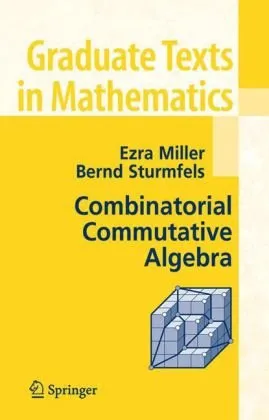
Ezra Miller,Bernd Sturmfels (auth.)
0 reviews
Published
pages
views
Introduction to Combinatorial Commutative Algebra Combinatorial Commutative Algebra is a fascinating intersection of algebraic theory and combinatorial structure, eloquently navigated by Ezra Miller and Bernd Sturmfels. This book serves as an essential text for adv
Before you read
Combinatorial Commutative Algebra is a fascinating intersection of algebraic theory and combinatorial structure, eloquently navigated by Ezra Miller and Bernd Sturmfels. This book serves as an essential text for advanced mathematics students, researchers, and academics who seek to explore the deep connections between algebra and combinatorics. By addressing complex topics such as polynomial ideals, simplicial complexes, and convex polytopes, this book presents traditional concepts through a modern, combinatorial lens.
The book begins with an introduction to the fundamental tools necessary for understanding combinatorial commutative algebra, including basics of polynomial rings and monomial ideals. From there, it explores the intriguing world of Gröbner bases, showcasing how these structures serve as a bridge between combinatorial and algebraic theories. Readers are guided through the nuances of square-free monomial ideals and the correspondence between algebraic varieties and combinatorial objects such as graphs and simplicial complexes.
As the chapters progress, the authors delve into a diverse array of advanced topics, such as the study of Hilbert functions and resolutions, as well as the concept of toric varieties, which showcases the deep-seated links between polytopes and algebraic geometry. Chapter by chapter, the book builds momentum, presenting increasingly sophisticated methods like Stanley-Reisner theory, and examining their implications on both theory and real-world applications.
Moreover, the book offers a plethora of examples and exercises, solidifying the reader's comprehension. These exercises are designed to challenge and provoke critical thinking, encouraging the application of newly-acquired knowledge. The inclusion of computational aspects allows readers to practice implementing algorithms and visualizing the algebraic structures they are studying.
Combinatorial Commutative Algebra provides not only a comprehensive introduction to its field but also furnishes readers with an in-depth understanding of intricate mathematical concepts. Key takeaways from the book include:
Here are some quotes from the book that encapsulate the spirit and depth of its content:
"Combinatorial commutative algebra is about constructing bridges between two islands that enliven our understanding of mathematics."
"The power of simplicity in computational algebra lies in its ability to peel away layers of complexity to reveal underlying combinatorial beauty."
Combinatorial Commutative Algebra occupies a vital role in modern mathematics. The text not only introduces its readers to fundamental concepts but also enriches their understanding by linking seemingly disparate areas of arithmetic, geometry, and logic. The significance of this book lies in its ability to demonstrate the interconnectedness of mathematical fields, breaking down traditional silos.
For those venturing into advanced algebra or combinatorics, this book is a wellspring of knowledge, clarifying theoretical concepts while simultaneously equipping readers with practical analytical tools. By fostering an appreciation for the inherent beauty and symmetry in algebraic structures, Miller and Sturmfels inspire a new generation of mathematically-inclined critical thinkers. In an era where interdisciplinary competence is increasingly crucial, this book is a potent resource in promoting intellectual flexibility and innovative problem-solving skills.
Your question is answered in the context of this title and author. Each answer uses 2 points.
0 reviews, 4.8 average out of 5
Sign in to publish a review.
Ask a focused question and learn from the community.
Related references that continue this learning path.
Damien Calaque,Carlo A. Rossi