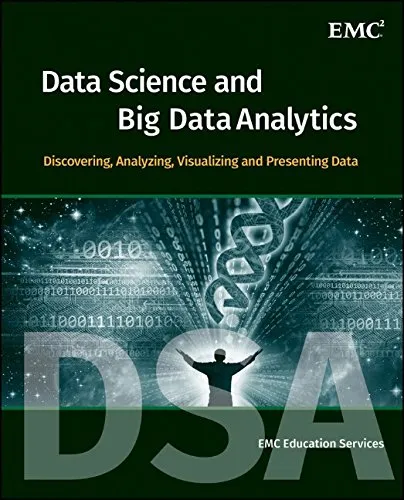
Data Science and Big Data Analytics: Discovering, Analyzing, Visualizing and Presenting Data
EMC Education Services
2015
View book
Book guide and evaluation
Dzwinel W.,Yuen D.A.,Boryczko K.
0 reviews
Published
pages
views
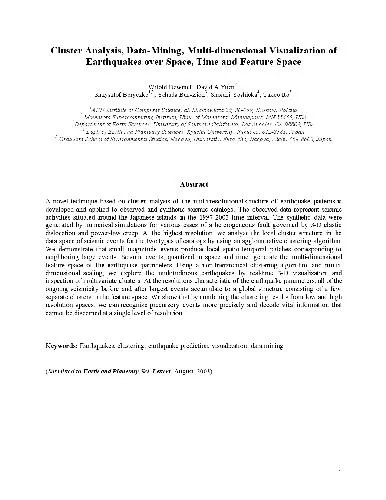
Introduction The book 'Cluster Analysis, Data-Mining, Multi-dimensional Visualization of Earthquakes over Space, Time and Feature Space' serves as a comprehensive guide to the advanced methodologies used in analyzing seismic data. By combining the disciplines of computational
Before you read
The book 'Cluster Analysis, Data-Mining, Multi-dimensional Visualization of Earthquakes over Space, Time and Feature Space' serves as a comprehensive guide to the advanced methodologies used in analyzing seismic data. By combining the disciplines of computational science, data mining, and seismology, this work bridges the gap between raw data extraction and meaningful interpretation. Authored by Dzwinel W., Yuen D.A., and Boryczko K., the book delves into multi-dimensional methods to unravel insights into earthquake behavior, providing a thorough framework for academics, professionals, and researchers alike.
Earthquake data is inherently multi-dimensional, spanning time, spatial dimensions, and various physical features. Traditional line-by-line analysis proves inadequate in understanding the intricacies embedded within such complex datasets. This book emphasizes utilizing advanced computational methods, such as cluster analysis and multi-dimensional visualization, to uncover patterns and anomalies that are otherwise hidden. As large-scale datasets from seismic activities become increasingly available, this book offers readers the tools they need to derive meaningful analyses at both micro and macro scales.
This book is not merely a technical manual, but also a narrative on how data visualizations and advanced clustering techniques can transform how we perceive seismic phenomena. It is a journey into understanding earthquakes' behavior from a perspective rooted in modern computational science. Whether you're a seasoned researcher or a technical enthusiast, this book provides actionable insights, foundational methodologies, and fresh perspectives to handle seismic data challenges effectively.
Cluster Analysis, Data-Mining, Multi-dimensional Visualization of Earthquakes is structured around three primary themes: clustering methods, data-mining tools, and visual analysis of multi-dimensional datasets. The book begins with an overview of the fundamental problems in seismic data interpretation. It then introduces state-of-the-art clustering algorithms designed to detect and group similar patterns within earthquake datasets, while also bridging the gap between the physical geography of seismic events and their temporal characteristics.
Throughout the chapters, the authors systematically discuss methods for visualizing high-dimensional seismic data. Visualization isn't treated merely as a presentation method but as an analytical tool essential for identifying underlying trends and anomalies. Key concepts like feature-space exploration and its significance in extracting actionable knowledge are thoroughly explained, ensuring even newcomers to the topic can follow along.
The text is enriched with case studies, applying theoretical frameworks to real-world seismic events. This approach moves beyond theory to demonstrate how cluster analysis and data-mining techniques work in practice. Whether mapping aftershock sequences or analyzing spatial patterns of tectonic activity, this book showcases innovative approaches to problem-solving in geophysics.
"Earthquakes do not exist solely in space or time but in a multi-dimensional reality where patterns and anomalies await discovery."
"Cluster analysis is not merely a tool; it is a lens through which the hidden order of seismic chaos reveals itself."
Seismic activity is one of the most unpredictable and consequential natural phenomena. Understanding its underlying patterns is critical, not just for advancing geophysical research but also for improving disaster preparedness across the globe. This book equips readers with the knowledge to explore seismic data beyond traditional approaches, diving deeper into the subtle interconnections hidden in multi-dimensional feature space.
By focusing on the computational aspects of earthquakes, the book brings a new perspective that is crucial in today's data-centric world. Its blend of theory, algorithms, and practical applications makes it a vital resource for anyone seeking to understand or mitigate the threats posed by earthquakes. From geophysicists to data scientists, this book provides powerful tools and methodologies that matter in research and practice alike.
In an era where big data governs decision-making, 'Cluster Analysis, Data-Mining, Multi-dimensional Visualization of Earthquakes over Space, Time and Feature Space' is a timely resource for professionals and institutions working to make sense of seismic complexities. The book's multi-disciplinary approach ensures its relevance across various scientific fronts, emphasizing why this work holds significance in both academia and practical disaster management.
Your question is answered in the context of this title and author. Each answer uses 2 points.
0 reviews, 4.0 average out of 5
Sign in to publish a review.
Ask a focused question and learn from the community.
Related references that continue this learning path.
EMC Education Services


Zach Gemignani,Chris Gemignani,Richard Galentino,Patrick Schuermann