

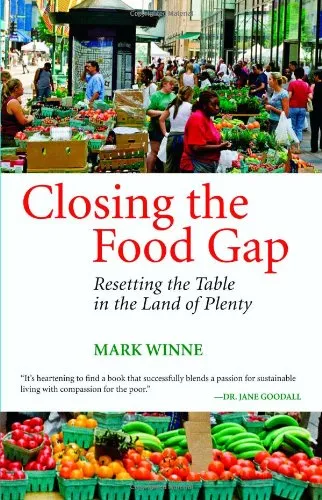
Book guide and evaluation
Closing the Food Gap: Resetting the Table in the Land of Plenty
Mark Winne
English
Beginner
Art
4.4 / 5
0 reviews
2008
Published
222
pages
223
views
Introduction to "Closing the Food Gap: Resetting the Table in the Land of Plenty" "Closing the Food Gap: Resetting the Table in the Land of Plenty" is a thought-provoking exploration of food justice, inequality, and the growing disparity in access to healthy, affordable, and c
Before you read
What will you get from this book?
Introduction to "Closing the Food Gap: Resetting the Table in the Land of Plenty"
"Closing the Food Gap: Resetting the Table in the Land of Plenty" is a thought-provoking exploration of food justice, inequality, and the growing disparity in access to healthy, affordable, and culturally appropriate food in America. Written by Mark Winne, this impactful book dives deep into the socio-economic dimensions of how food is produced, distributed, and consumed, while shedding light on the broader systemic issues that perpetuate food insecurity and hunger. With decades of experience in food justice advocacy, the author takes readers on a journey across urban and rural America, weaving together personal stories, historical context, and critical analysis of public policies that shape the nation’s food system today.
The book offers both an exposé of the "food gap" affecting millions of Americans and a hopeful framework for building more equitable solutions. Challenging conventional notions of charity and quick fixes, Mark Winne advocates for community-driven approaches that empower marginalized communities to regain control over their food systems and build sustainable food security. Accessible yet deeply engaging, this book is essential reading for anyone passionate about social justice, food equity, and creating a healthier society.
Detailed Summary of the Book
"Closing the Food Gap" takes a critical look at why food insecurity persists even in a nation as wealthy as the United States. The book begins with a sobering reality: while many Americans enjoy unprecedented abundance, millions live in communities with limited or no access to fresh and nutritious food, often termed as "food deserts." Through a mixture of personal anecdotes and rigorous analysis, Mark Winne explores the historical and structural roots of this issue.
Winne discusses his experiences working with food programs and community organizations, highlighting both the triumphs and shortcomings of these initiatives. He examines the rise of farmers' markets, community-supported agriculture, and urban gardens, noting their potential to shrink the food gap while criticizing their limitations in serving low-income communities. Furthermore, the book critiques the charitable food system, such as food banks and soup kitchens, arguing that while they address immediate hunger, they often fail to address the systemic causes of poverty and food insecurity.
Ultimately, the book outlines a compelling vision for achieving food justice. Winne advocates for policies and practices that support sustainable agriculture, empower local food economies, and prioritize universal access to wholesome, affordable food. The solution, as he writes, lies in transcending charity and moving toward equity and empowerment.
Key Takeaways
- Food insecurity affects both rural and urban areas alike, often disproportionately impacting marginalized communities.
- Charitable food systems, while necessary to address immediate hunger, can unintentionally perpetuate dependency rather than solving the root causes of food insecurity.
- Community-driven initiatives like urban farming and farmers' markets can be part of the solution, but they need to be made accessible to low-income populations.
- Public policy changes, including support for local agriculture, fair wages, and equitable land distribution, hold the key to achieving food equity.
- Sustainable solutions to the food gap require collaboration between nonprofits, governments, businesses, and everyday citizens to create systemic change.
Famous Quotes from the Book
"Hunger is not caused by the scarcity of food but by the scarcity of democracy."
"A food system based on charity might fill empty stomachs, but it will never liberate hungry people."
"The solution to hunger is not more food banks. It is more justice."
Why This Book Matters
The importance of "Closing the Food Gap" cannot be overstated in today’s world, where food inequality remains a pressing global and local issue. This book is not just about food; it is fundamentally about social justice, equity, and the right to live with dignity. Understanding how food policies and systems intersect with poverty and discrimination enables readers to see the invisible structures that perpetuate inequality.
Mark Winne’s work is especially relevant to activists, policymakers, and community leaders who are looking for holistic approaches to bridging the food gap. The call to rethink food systems resonates broadly, encouraging individuals and communities alike to innovate and advocate for inclusive, sustainable solutions. By addressing the systemic causes of food insecurity and proposing actionable paths forward, "Closing the Food Gap" serves as both a wake-up call and a guide for fostering meaningful change.
Ask this book
Your question is answered in the context of this title and author. Each answer uses 2 points.
Sign in to ask the book assistant.
Reader reviews
0 reviews, 4.4 average out of 5
No reviews yet
If you have read this book, help the next reader with your experience.
Write a review
Sign in to publish a review.
Reader questions and answers
Ask a focused question and learn from the community.
Sign in to ask or answer a question.
No questions yet
Be the first to ask a clear, useful question.
What to read next
Related references that continue this learning path.



Modern Computer Vision with PyTorch: A Practical Roadmap From Deep Learning Fundamentals to Advanced Applications and Generative AI, 2nd Edition
V Kishore Ayyadevara,Yeshwanth Reddy
2023
View book