Loading
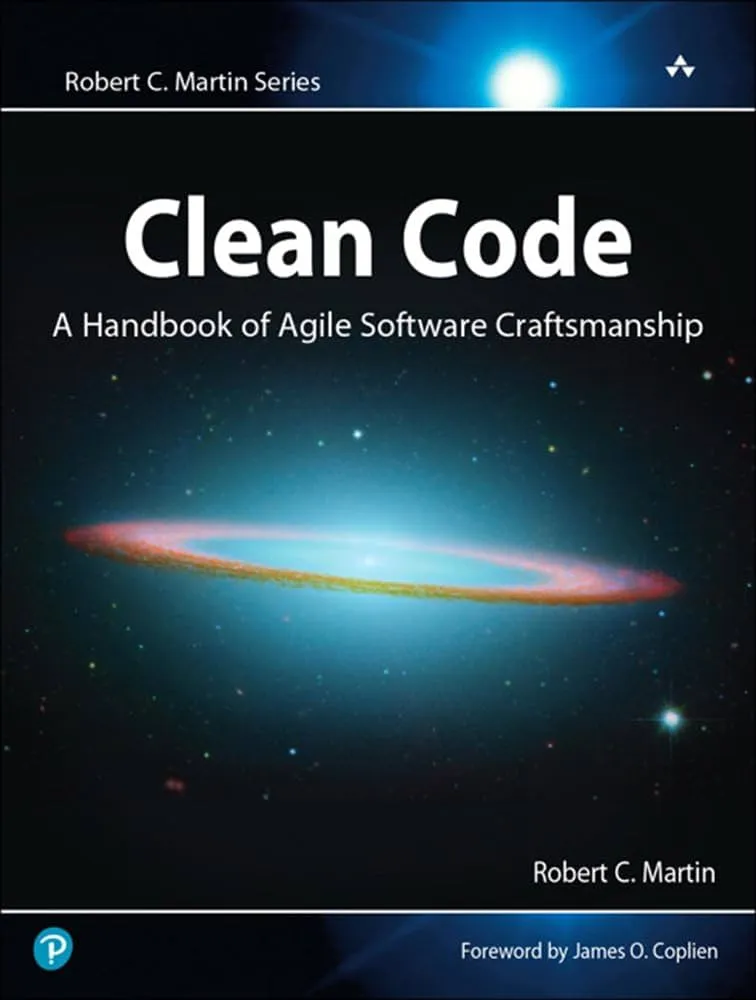
Cover of Clean Code: A Handbook of Agile Software Craftmanship

RefHub featured

English Advanced Software Engineering

Clean Code: A Handbook of Agile Software Craftmanship

Martin,Robert C

Robert C. Martin

5.0 / 5

2 reviews

2010

Published

443

pages

1646

views

Clean Code A Handbook of Agile Software Craftmanship - A Comprehensive Guide Written by Robert C. Martin also known as "Uncle Bob" 'Clean Code A Handbook of Agile Software Craftmanship' is a highly acclaimed book that has revolutionized the way developers approach software des

About this book

Clean Code A Handbook of Agile Software Craftmanship - A Comprehensive Guide

Written by Robert C. Martin also known as "Uncle Bob" 'Clean Code A Handbook of Agile Software Craftmanship' is a highly acclaimed book that has revolutionized the way developers approach software design and development. The book focuses on the principles and best practices of writing clean maintainable and efficient code which is essential for any successful software project.

Detailed Summary of the Book

The book is divided into three main sections principles case studies and heuristics. The first section delves into the principles of clean code including the importance of naming functions error handling and boundaries. Martin emphasizes the need for developers to take responsibility for the quality of their code and to strive for simplicity clarity and elegance.

The second section presents several case studies that demonstrate the application of clean code principles in real-world scenarios. These case studies cover a range of topics from simple algorithms to complex system design and provide valuable insights into the thought process and decision-making involved in writing clean code.

The third section focuses on heuristics which are guidelines or rules of thumb that can help developers make better decisions when writing code. Martin discusses various heuristics including the Law of Demeter the Single Responsibility Principle and the Open-Closed Principle and explains how these heuristics can be applied in different contexts.

Key Takeaways

  • The importance of naming Martin emphasizes the need for clear descriptive and consistent naming conventions to make code easier to understand and maintain.
  • Functions The book highlights the importance of short focused functions that perform a single task and have minimal side effects.
  • Error handling Martin stresses the need for robust error handling mechanisms that can detect and recover from errors in a predictable and reliable manner.
  • Boundaries The book discusses the importance of defining clear boundaries between different components and systems to ensure loose coupling and high cohesion.
  • Test-driven development Martin advocates for test-driven development as a means of ensuring that code is testable maintainable and meets the required functionality.

Famous Quotes from the Book

"Clean code is not just about aesthetics it's about survivability. It's about making the codebase easy to understand modify and extend."

"The only way to make the deadlinethe only way to go fastis to keep the code clean."

"A good system is one that is easy to change and a good design is one that makes it easy to change the system."

Why This Book Matters

'Clean Code A Handbook of Agile Software Craftmanship' is a must-read for any software developer regardless of their level of experience or expertise. The book provides a comprehensive guide to writing clean maintainable and efficient code which is essential for any successful software project.

The book's focus on principles case studies and heuristics makes it a valuable resource for developers who want to improve their coding skills and produce high-quality software. The book's emphasis on simplicity clarity and elegance also makes it a great resource for developers who want to improve their overall design and development skills.

Furthermore the book's relevance extends beyond software development to other fields such as engineering architecture and design where the principles of clean code can be applied to improve the quality and maintainability of designs and systems.

Audio introductions

Persian Summary

Ask this book

Your question is answered in the context of this title and author. Each answer uses 2 points.

Sign in to ask the book assistant.

Your previous questions

Explain more about outpost design pattern
The Outpost design pattern! It's a fascinating topic in the realm of software craftsmanship. In my book, Clean Code, I like to think of the Outpost pattern as a way to encapsulate a complex piece of code within a contained unit. In essence, the Outpost pattern suggests that when a piece of code has become too complex to reason about or maintain, we should "repurpose" it into a separate, isolated module. This module, the Outpost, becomes a "walled-off" area, entirely responsible for its own behavior, hiding its implementation details from the rest of the system. The idea is that by doing so, we reduce the cognitive load of understanding the system's behavior and make it easier to modify or extend specific features without polluting the surrounding codebase. Think of it like creating a "hermetic" environment for a specific piece of code, shielding it from the rest of the system's intricacies. To implement the Outpost pattern, you'd typically: 1. Identify complex code that requires isolation. 2. Create a new module (the Outpost) for this code. 3. Extract the necessary functions, data, and logic into the Outpost. 4. Ensure the Outpost is self-contained and communicates with the rest of the system through a clear interfaces (e.g., APIs). By doing this, we achieve several benefits: * Decreased coupling between modules: The Outpost is now responsible for its own behavior, reducing the dependencies between modules. * Isolated complexity: The specific complexity of the Outpost is contained and hidden from the rest of the system. * Improved maintainability: With the Outpost's concise and contained implementation, maintenance and updates become easier. When applied judiciously, the Outpost pattern can lead to cleaner, more manageable codebases. What are your thoughts on this pattern? Have you used it in your own projects?
این کتاب درباره چیه؟
"Clean Code" is a book about writing maintainable and efficient software code. It's not just about the syntax and semantics of programming languages, but about the principles and best practices that help you create software that is easy to understand, modify, and extend over time. The book focuses on the importance of abstraction, simplicity, and clarity in software development, and provides guidance on how to achieve these goals. It covers a wide range of topics, including functions, objects, data structures, and algorithms, as well as more specific topics such as how to write readable code, how to use design patterns effectively, and how to test and debug your code. The book is not just about the technical aspects of programming, but also about the importance of software craftsmanship, which includes values like simplicity, flexibility, and continuous improvement. It encourages developers to take a holistic approach to software development, and to strive for excellence in their craft.
Give me a simple python code for showing a message in console
Here is a simple Python code that prints a message to the console: ``` print("Hello, world!") ``` This is a classic "Hello, world!" program in Python.

Reader reviews

2 reviews · 5.0 average out of 5

amir

2023/11/26

5 / 5

بخونید و رعایت کنید!

ali12

2024/12/17

5 / 5

یکی از اولین کتاب‌هایی که من در حوزه برنامه نویسی خوندم(البته بجز کتاب‌های درسی) و بسیار مفید و آموزنده بود. به همه برنامه‌نویس‌ها پیشنهادش می‌کنم.

Write a review

Sign in to publish a review.

Reader questions and answers

Ask a focused question and learn from the community.

Sign in to ask or answer a question.

No questions yet

Be the first to ask a clear, useful question.

Related references that continue this learning path.