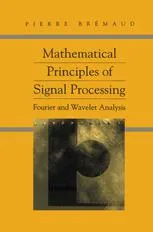
Mathematical Principles of Signal Processing: Fourier and Wavelet Analysis
Pierre Brémaud (auth.)
2002
View book
Book guide and evaluation
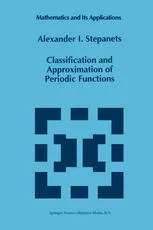
Alexander I. Stepanets (auth.)
0 reviews
Published
pages
views
Welcome to the comprehensive exploration of periodic functions, as presented in "Classification and Approximation of Periodic Functions" by Alexander I. Stepanets. This pivotal work delves into the intricacies of mathematical analysis, offering readers a profound understanding
Before you read
Welcome to the comprehensive exploration of periodic functions, as presented in "Classification and Approximation of Periodic Functions" by Alexander I. Stepanets. This pivotal work delves into the intricacies of mathematical analysis, offering readers a profound understanding of the classification and approximation processes concerning periodic functions. Crafted for both seasoned mathematicians and enthusiastic scholars, Stepanets’ book is a valuable resource that bridges gaps in existing literature with its innovative approach and rigorous analysis.
Stepanets sets the stage by addressing the foundational aspects of periodic functions, ensuring that readers grasp the essential definitions and properties that underlie this mathematical concept. The book begins with an introduction to the general properties of periodic functions, examining their behavior, continuity, and differentiability. It then transitions into a detailed discussion on the classification of these functions, categorizing them based on various characteristics and properties. This section is crucial, as it provides a framework for understanding the diverse nature of periodic functions and their applications in different mathematical domains.
The core of the book is its thorough examination of approximation theory. Stepanets meticulously explores the methods used to approximate periodic functions, focusing on sequence convergence and Fourier series. He presents a range of approximation techniques, including polynomial and trigonometrical approximations, providing insights into their efficiency, accuracy, and practical implementation. Throughout, the author emphasizes the importance of these approximations in solving complex mathematical problems and advancing analytical computation.
In the latter chapters, Stepanets tackles more sophisticated topics, such as harmonic analysis and spectral theory, enriching the reader’s understanding of the multifaceted applications of periodic functions. Comprehensive examples and problems are interspersed throughout the text to reinforce learning and catalyze deeper inquiry into the subject matter.
"Periodic functions, much like the universe, exhibit a rhythmic precision that captures the essence of continuity and change."
"Approximation is not merely a tool; it is the lens through which we fine-tune our understanding of mathematical reality."
The importance of "Classification and Approximation of Periodic Functions" lies not only in its academic contributions but also in its practical implications across various fields of science and engineering. The ability to understand and approximate periodic phenomena is integral to advancements in fields such as signal processing, acoustics, and telecommunications. Stepanets’ methodical approach provides a blueprint for further research, offering a robust theoretical foundation upon which future innovations can be built.
Moreover, the book fills a critical void in mathematical literature by addressing both the theoretical underpinnings and practical applications of periodic functions. It empowers readers to apply mathematical theory in tangible contexts, enhancing their analytical capabilities and fostering a deeper appreciation for the elegance of mathematics.
Your question is answered in the context of this title and author. Each answer uses 2 points.
0 reviews, 4.6 average out of 5
Sign in to publish a review.
Ask a focused question and learn from the community.
Related references that continue this learning path.
Pierre Brémaud (auth.)