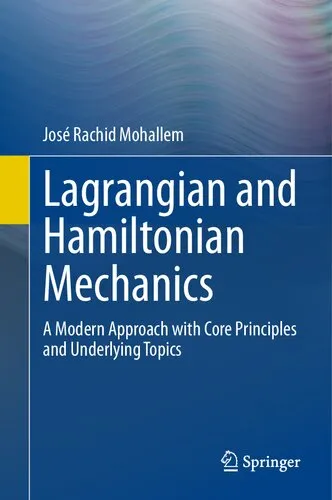
Lagrangian and Hamiltonian Mechanics : A Modern Approach with Core Principles and Underlying Topics
José Rachid Mohallem
2024
View book
Book guide and evaluation
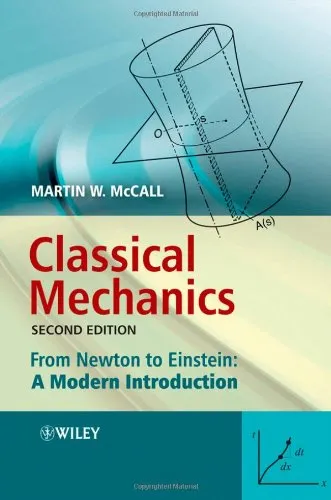
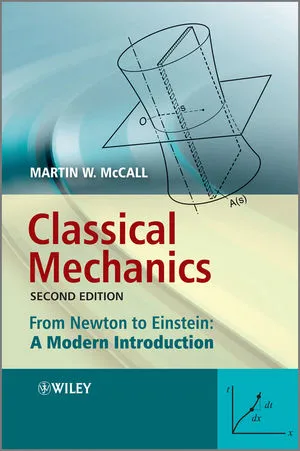
Martin W. McCall(auth.)
0 reviews
Published
pages
views
Welcome to the second edition of "Classical Mechanics: From Newton to Einstein: A Modern Introduction." This comprehensive book delves into the intricate world of classical mechanics, bridging foundational concepts to more complex applications, all through a modern lens. This e
Before you read
Welcome to the second edition of "Classical Mechanics: From Newton to Einstein: A Modern Introduction." This comprehensive book delves into the intricate world of classical mechanics, bridging foundational concepts to more complex applications, all through a modern lens. This edition is meticulously crafted to cater to both students and enthusiasts eager to understand the classical underpinnings of modern physics.
The journey through classical mechanics begins with the profound insights of Sir Isaac Newton, whose laws of motion and universal gravitation form the bedrock of our understanding of physical phenomena. The narrative then advances through the centuries, encapsulating pivotal developments in mechanics that have transformed theoretical physics and applied sciences. This book serves as an intellectual passage from Newtonian mechanics to Einstein’s fascinating theories of relativity.
Accompanied by rigorous mathematical formulations and captivating discussions, the book covers crucial topics such as kinematics, dynamics, and the conservation principles. It introduces the Lagrangian and Hamiltonian formulations and explores their powerful implications in solving complex mechanical problems. Furthermore, the text elegantly integrates Einstein's theory of relativity, providing a natural progression from the classical Newtonian framework.
"Newton's laws of motion are simple yet profound, laying the groundwork for the evolution of scientific thought."
"Einstein did not outright reject classical mechanics; rather, he expanded upon it, unveiling the new horizon of relativity."
In an era where ideas from quantum mechanics and relativity often dominate the discourse, there is immense value in revisiting the bedrock of classical mechanics. This book does more than just recount historical scientific developments; it provides the reader with robust analytical skills and a deep appreciation for the intertwined nature of classical and modern physics.
Whether you are a student beginning your journey into the physical sciences or an experienced scholar seeking to reconnect with the foundations of physics, this book is an invaluable resource. It not only reinforces fundamental concepts but also encourages critical thinking and exploration of complex physical systems. The seamless integration of classical mechanics with modern developments, particularly the brilliant transition to Einstein's relativity, highlights the enduring relevance and sophistication of this field.
Your question is answered in the context of this title and author. Each answer uses 2 points.
0 reviews, 4.5 average out of 5
Sign in to publish a review.
Ask a focused question and learn from the community.
Related references that continue this learning path.
José Rachid Mohallem
Stephen T.(Stephen T. Thornton) Thornton,Jerry B. Marion