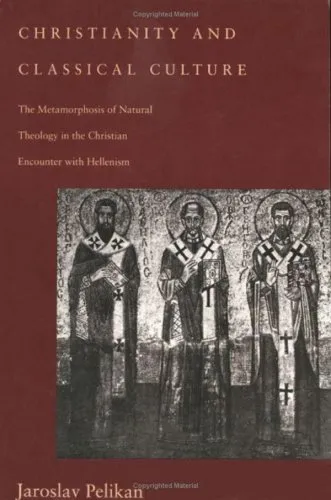
Book guide and evaluation
Christianity and Classical Culture: The Metamorphosis of Natural Theology in the Christian Encounter with Hellenism
Jaroslav Pelikan
English
Intermediate
novel
4.2 / 5
0 reviews
1993
Published
379
pages
582
views
Introduction to "Christianity and Classical Culture: The Metamorphosis of Natural Theology in the Christian Encounter with Hellenism" The profound interaction between Christianity and Hellenistic philosophy symbolizes one of the most transformative epochs in the history of
Before you read
What will you get from this book?
Introduction to "Christianity and Classical Culture: The Metamorphosis of Natural Theology in the Christian Encounter with Hellenism"
The profound interaction between Christianity and Hellenistic philosophy symbolizes one of the most transformative epochs in the history of Western thought. In "Christianity and Classical Culture: The Metamorphosis of Natural Theology in the Christian Encounter with Hellenism," we explore how these two monumental intellectual traditions engaged, confronted, and ultimately influenced each other in shaping the development of Christian doctrine and cultural identity.
Detailed Summary of the Book
This book meticulously examines the intricate relationship between Christianity and the diverse strands of classical culture as epitomized in Greek philosophical thought. Jaroslav Pelikan illuminates the multiple dimensions through which early Christian thinkers absorbed and redefined elements of natural theology — an integral component of Hellenistic philosophy that dealt with human understanding of the divine through reason and observation of the natural world.
Pelikan's narrative embarks on a comprehensive exploration of key figures and texts from both traditions. Initially, the book delves into the period known as the Patristic Era, tracing the works of early church fathers like Justin Martyr, Clement of Alexandria, and Origen, who sought to draw parallels between Christian teachings and Platonic ideals. As Christianity moved from being a persecuted sect to becoming the state religion of the Roman Empire, these interactions became more sophisticated. The author highlights the contributions of Augustine of Hippo and later thinkers in synthesizing elements of Aristotelian thought with Christian doctrine.
By scrutinizing historical contexts, Pelikan illustrates the dialogue between faith and reason, showcasing how this interaction was not merely a scholarly exercise but a defining process that transformed how Christians understood God, the cosmos, and humanity's place within it.
Key Takeaways
- The encounter with Hellenistic philosophy compelled Christianity to articulate its doctrine with greater clarity and philosophical rigor.
- Natural theology served as a bridge, facilitating the reconciliation of reason and revelation within a Christian framework.
- The synthesis of these traditions contributed to the development of Christian humanism, which became influential in later medieval and Renaissance thought.
- The book challenges modern assumptions about the separation between faith and reason, illustrating their historical interdependence.
Famous Quotes from the Book
"The encounter between Christianity and Hellenism was not a mere absorption of the latter into the former, but a transformative process that enriched both traditions."
"In the dialogue between faith and reason, the early Christian thinkers found not contradictions but complementary perspectives that deepened the mystery of divine truth."
Why This Book Matters
This book holds significant relevance for both scholars and lay readers interested in understanding the historical dynamics between different systems of thought. By focusing on the intellectual metamorphosis that occurred as Christianity engaged with classical culture, Pelikan not only provides an academic account but also invites readers to reflect on the continuing relevance of these dialogues in today's world. At a time when there is renewed interest in the ways religion interacts with various cultural and philosophical movements, this work stands as a testament to how past dialogues can inform present and future inquiries into the coexistence and compatibility of diverse intellectual traditions.
Ask this book
Your question is answered in the context of this title and author. Each answer uses 2 points.
Sign in to ask the book assistant.
Reader reviews
0 reviews, 4.2 average out of 5
No reviews yet
If you have read this book, help the next reader with your experience.
Write a review
Sign in to publish a review.
Reader questions and answers
Ask a focused question and learn from the community.
Sign in to ask or answer a question.
No questions yet
Be the first to ask a clear, useful question.
What to read next
Related references that continue this learning path.