
Refugee Education across the Lifespan: Mapping Experiences of Language Learning and Use (Educational Linguistics, 50)
Doris S. Warriner (editor)
2021
View book
Book guide and evaluation
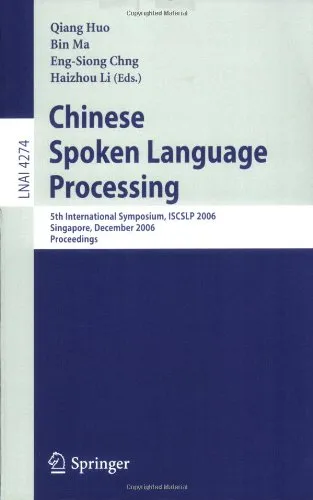
Stephanie Seneff (auth.),Qiang Huo,Bin Ma,Eng-Siong Chng,Haizhou Li (eds.)
0 reviews
Published
pages
views
Introduction The book "Chinese Spoken Language Processing: 5th International Symposium, ISCSLP 2006, Singapore, December 13-16, 2006. Proceedings" is an essential compilation of groundbreaking research and advancements in the field of Chinese spoken language processing. This v
Before you read
The book "Chinese Spoken Language Processing: 5th International Symposium, ISCSLP 2006, Singapore, December 13-16, 2006. Proceedings" is an essential compilation of groundbreaking research and advancements in the field of Chinese spoken language processing. This volume represents the proceedings of the 5th International Symposium on Chinese Spoken Language Processing (ISCSLP), bringing together scholars, researchers, and practitioners to explore innovative approaches and key trends in this rapidly evolving domain. The conference serves as a prominent platform for the dissemination and exchange of ideas that are central to the advancement of speech-processing technologies for Chinese and related languages.
Published as part of the Lecture Notes in Computer Science series, this book contains a comprehensive collection of research papers presented at ISCSLP 2006. It addresses a wide range of topics including speech recognition, speech synthesis, natural language processing, machine learning in language processing, and the integration of speech technologies with artificial intelligence.
The book highlights unique challenges associated with Chinese spoken language due to its tonal nature, large vocabulary, and complex structure. It also investigates solutions for linguistic difficulties such as polysemy and homophones, which are intricately connected to both written and spoken Chinese.
The contributions within provide insights into novel methodologies, such as the use of statistical modeling, phonetic rules for tonal languages, and optimization algorithms to improve real-time processing accuracy. Touching upon both fundamental research and practical applications, the book discusses real-world systems for automatic speech recognition (ASR), text-to-speech (TTS) systems, and robust speaker verification technologies.
"Speech processing for Chinese languages is not merely about developing algorithms; it is about bridging the gap between human communication and technological interpretation in a linguistically complex world."
"As we push the boundaries of artificial intelligence, spoken language understanding continues to be a cornerstone of effective and intuitive human-computer interaction."
"Despite the challenges posed by tonal variations, large contextual ambiguities, and polysemous characters, advances in speech technologies are steadily conquering these hurdles through innovation and perseverance."
This book is a cornerstone for anyone interested in understanding the intricacies of Chinese spoken language processing, both from an academic and practical perspective. It compiles significant contributions from leading experts in the field, capturing the state-of-the-art methodologies and research challenges of the time.
In an era where voice technologies are becoming increasingly important, the book has vast implications for developing future speech technologies that serve millions of Chinese-language speakers globally. Its insights into the complexities of tonal languages and integration with AI frameworks offer valuable references for academics, practitioners, and industry professionals pioneering the next generation of smart systems.
By addressing the core challenges of Chinese spoken language, this volume lays the foundation for building highly functional ASR and NLU (Natural Language Understanding) systems that are crucial for systems like voice-activated assistants, real-time translation services, and other conversational AI applications. Furthermore, the interdisciplinary nature of this book makes it a key resource for researchers working in linguistics, data science, AI, and human-computer interaction.
Your question is answered in the context of this title and author. Each answer uses 2 points.
0 reviews, 3.9 average out of 5
Sign in to publish a review.
Ask a focused question and learn from the community.
Related references that continue this learning path.
Doris S. Warriner (editor)

Jiro Akahori,Shigeyoshi Ogawa,Shinzo Watanabe