

Book guide and evaluation
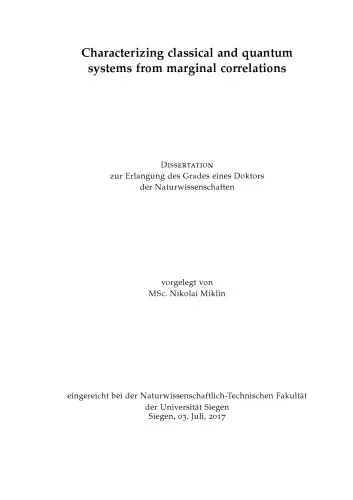
Characterizing classical and quantum systems from marginal correlations[PhD Thesis]
Nikolai Miklin
English
Beginner
Art
4.2 / 5
0 reviews
2017
Published
143
pages
142
views
Introduction to "Characterizing Classical and Quantum Systems from Marginal Correlations" Understanding the foundational principles that govern classical and quantum systems lies at the heart of modern physics and quantum information theory. My PhD thesis, "Characterizing Clas
Before you read
What will you get from this book?
Introduction to "Characterizing Classical and Quantum Systems from Marginal Correlations"
Understanding the foundational principles that govern classical and quantum systems lies at the heart of modern physics and quantum information theory. My PhD thesis, "Characterizing Classical and Quantum Systems from Marginal Correlations," seeks to unravel these complex concepts by exploring a profound link between classical and quantum systems through the lens of marginal correlations. In this work, I aim to provide both theoretical insights and practical implications for how systems in these realms can be understood, classified, and analyzed through their observable behaviors—specifically, their marginal probabilities or correlations.
Detailed Summary of the Book
The study of marginal correlations serves as a bridge that connects the classical and quantum domains. In quantum physics, measurements performed on subsystems of an entangled state often produce correlations that cannot be explained classically. These correlations are instrumental in tasks such as quantum cryptography, nonlocality tests, and the development of quantum technologies. However, the characterization of systems relying solely on these correlations poses significant challenges that require careful mathematical formulation and physical interpretation.
This PhD thesis explores approaches to address such challenges by utilizing marginal correlations as a diagnostic tool. Specifically, it systematically investigates the boundary between classical and quantum behaviors, evaluates constraints from physical principles such as no-signaling, and quantifies the extent to which quantum systems violate classical limits. The core of this work lies in demonstrating how marginal correlations, when lifted out of their mathematical abstraction, can paint an intuitive picture of deeper principles of quantum mechanics and its classical counterpart.
The thesis is divided into three major thematic areas. The first part lays the groundwork by establishing the theoretical framework and providing the necessary background on probability theory, tensor products, and Bell scenarios. The second part delves into the operational consequences of no-signaling correlations, while the third part focuses on leveraging these results to better understand the power and limitations of quantum systems compared to their classical counterparts. This extensive research contributes to the growing discourse in quantum foundations and quantum information theory.
The arguments and conclusions drawn in this work are supported through rigorous mathematical proofs, illustrative examples, and comparisons between classical and quantum paradigms. The thesis serves as a resource for researchers, physicists, and mathematicians seeking to expand their understanding of how systems evolve and interact under well-defined rules.
Key Takeaways
This book offers numerous insights, but the most significant takeaways include:
- How marginal correlations offer a versatile diagnostic tool for distinguishing between classical and quantum systems.
- The foundational role of physical principles, such as no-signaling, in constraining observable behavior in both classical and quantum contexts.
- The significance of Bell inequalities and their violation as a hallmark of quantum mechanics compared to classically local theories.
- The operational implications of quantum correlations, particularly in real-world scenarios such as quantum cryptography and communication complexes.
- The broader philosophical and theoretical questions surrounding the nature of reality that arise when these correlations are studied rigorously.
These takeaways underscore the bridge this thesis builds between theoretical physics and practical applications, enriching our understanding of classical and quantum systems.
Famous Quotes from the Book
Below are some notable excerpts from the thesis that encapsulate its depth and clarity:
"Marginal probabilities are not just abstract mathematical objects—they hold the key to distinguishing quantum systems from classical ones, offering a glimpse into the underlying mechanics of reality."
"No-signaling correlations not only abide by the constraints of causality but also exemplify the subtle ways in which quantum mechanics redefines what is physically possible."
"The boundary between classical and quantum systems is not merely academic; it is a frontier illuminating how the universe operates at its most fundamental level."
Why This Book Matters
In an era marked by the rapid development of quantum technologies, understanding the foundational principles of classical and quantum systems has never been more crucial. This book matters because it advances the discourse in several meaningful ways:
First, it contributes to the theoretical understanding of marginal correlations, providing rigorous tools and methodologies that can be employed in quantum research. These insights are not only academically significant but also hold considerable practical implications—for instance, in the design and verification of quantum systems and protocols.
Second, this thesis bridges classical and quantum physics, offering a comprehensive framework to analyze systems that were traditionally assumed to belong to one realm or the other. This synthesis is particularly useful as we navigate the complexities arising from hybrid systems in emerging technologies.
Finally, the book raises profound questions about the nature of reality, causality, and the universe’s underlying mathematical structure. By doing so, it invites a diverse audience—from physicists and mathematicians to philosophers and technologists—to engage with these fundamental issues.
The contributions within this work hold the potential to transform not only how we think about these systems but also how we innovate with them in the rapidly evolving field of quantum information science.
Ask this book
Your question is answered in the context of this title and author. Each answer uses 2 points.
Sign in to ask the book assistant.
Reader reviews
0 reviews, 4.2 average out of 5
No reviews yet
If you have read this book, help the next reader with your experience.
Write a review
Sign in to publish a review.
Reader questions and answers
Ask a focused question and learn from the community.
Sign in to ask or answer a question.
No questions yet
Be the first to ask a clear, useful question.
What to read next
Related references that continue this learning path.


Modern Computer Vision with PyTorch: A Practical Roadmap From Deep Learning Fundamentals to Advanced Applications and Generative AI, 2nd Edition
V Kishore Ayyadevara,Yeshwanth Reddy
2023
View book