
Book guide and evaluation
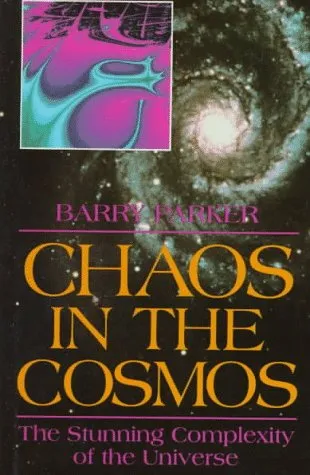
Chaos in the cosmos: the stunning complexity of the universe
Barry Parker
English
Unordered
Physics
4.5 / 5
0 reviews
1996
Published
316
pages
512
views
Introduction Welcome to "Chaos in the Cosmos: The Stunning Complexity of the Universe," a profound exploration of the intricate and bewildering dynamics that govern the universe. This book delves deep into the fascinating and often unpredictable nature of cosmic phenomena,
Before you read
What will you get from this book?
Introduction
Welcome to "Chaos in the Cosmos: The Stunning Complexity of the Universe," a profound exploration of the intricate and bewildering dynamics that govern the universe. This book delves deep into the fascinating and often unpredictable nature of cosmic phenomena, offering readers a compelling journey through astrophysics, chaos theory, and cosmology.
Detailed Summary of the Book
In "Chaos in the Cosmos," we begin by confronting one of the most intriguing paradoxes in science: how the universe, a vast and seemingly chaotic expanse, exhibits ordered patterns. This book explores the essence of chaos theory and its implications for understanding astronomical phenomena. From the swirling storms on Jupiter to the unpredictability of solar flares, chaos theory provides a unique lens through which we can observe and analyze cosmic events.
The narrative introduces readers to the foundational principles of chaos theory, including sensitive dependence on initial conditions and the butterfly effect. Each concept is illustrated using accessible examples from within our own solar system and beyond. The book takes a historical approach, tracing the development of chaos theory from its origins in Poincaré's work to its modern applications in astrophysics and space exploration.
This journey continues as we unravel the complexity found in star formation, galaxy dynamics, and the distribution of dark matter. We delve into how complex systems in the cosmos often evolve in ways that are fundamentally unpredictable, challenging the deterministic view that long dominated scientific thought.
Key Takeaways
- Chaos theory provides a powerful framework for understanding complex cosmic systems and phenomena.
- The universe, while largely unpredictable, exhibits emergent patterns and order that can be explained through mathematical models of chaos.
- Scientific and mathematical tools, like fractals and attractor models, offer significant insights into predicting cosmic behaviors.
- Understanding chaos can help address challenges in space exploration, predicting planetary weather, and interpreting signals from across the universe.
Famous Quotes from the Book
"When we look at the cosmos, the chaos is not a symptom of disorder, but a language that nature uses to speak to us about its complexity."
"In the heart of complexity lies simplicity, and in the heart of simplicity lies complexity—such is the paradox of the cosmos."
"Chaos does not mean randomness or noise; it means a higher form of order we are just beginning to understand."
Why This Book Matters
"Chaos in the Cosmos" matters because it bridges the gap between abstract scientific concepts and their practical implications in understanding the universe. This work invites readers at all levels of scientific knowledge to engage with challenging ideas that redefine how we perceive cosmic order and development. It delivers a compelling case for why chaos theory is not just a theory, but a vibrant field that continues to transform our understanding of the universe. As we navigate an era rich with discoveries and technological advancements, this book provides the necessary context and insight to appreciate the true complexity of everything from the smallest particles to the largest galactic clusters.
Ultimately, the book inspires a new generation of thinkers—scientists and enthusiasts alike—to explore the boundaries of what is known and to embrace the chaos that defines our cosmos.
Ask this book
Your question is answered in the context of this title and author. Each answer uses 2 points.
Sign in to ask the book assistant.
Reader reviews
0 reviews, 4.5 average out of 5
No reviews yet
If you have read this book, help the next reader with your experience.
Write a review
Sign in to publish a review.
Reader questions and answers
Ask a focused question and learn from the community.
Sign in to ask or answer a question.
No questions yet
Be the first to ask a clear, useful question.
What to read next
Related references that continue this learning path.

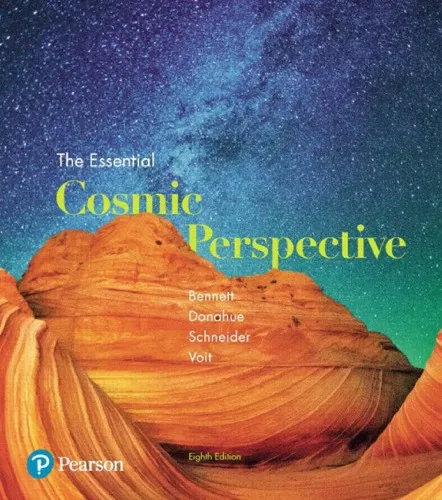
The Essential Cosmic Perspective (8th Edition)
Jeffrey O. Bennett,Megan O. Donahue,Nicholas Schneider,Mark Voit
2018
View book