

Book guide and evaluation
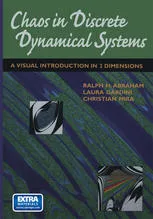
Chaos in Discrete Dynamical Systems: A Visual Introduction in 2 Dimensions
Ralph H. Abraham,Laura Gardini,Christian Mira (auth.)
English
Beginner
Mathematics
4.4 / 5
0 reviews
1997
Published
257
pages
229
views
Chaos Theory is a synonym for dynamical systems theory, a branch of mathematics. Dynamical systems come in three flavors: flows (continuous dynamical systems), cascades (discrete, reversible, dynamical systems), and semi-cascades (discrete, irreversible, dynamical systems). Flows
Before you read
What will you get from this book?
Chaos Theory is a synonym for dynamical systems theory, a branch of mathematics. Dynamical systems come in three flavors: flows (continuous dynamical systems), cascades (discrete, reversible, dynamical systems), and semi-cascades (discrete, irreversible, dynamical systems). Flows and semi-cascades are the classical systems iuntroduced by Poincare a centry ago, and are the subject of the extensively illustrated book: "Dynamics: The Geometry of Behavior," Addison-Wesley 1992 authored by Ralph Abraham and Shaw. Semi- cascades, also know as iterated function systems, are a recent innovation, and have been well-studied only in one dimension (the simplest case) since about 1950. The two-dimensional case is the current frontier of research. And from the computer graphcis of the leading researcher come astonishing views of the new landscape, such as the Julia and Mandelbrot sets in the beautiful books by Heinz-Otto Peigen and his co-workers. Now, the new theory of critical curves developed byMira and his students and Toulouse provide a unique opportunity to explain the basic concepts of the theory of chaos and bifurcations for discete dynamical systems in two-dimensions. The materials in the book and on the accompanying disc are not solely developed only with the researcher and professional in mind, but also with consideration for the student. The book is replete with some 100 computer graphics to illustrate the material, and the CD-ROM contains full-color animations that are tied directly into the subject matter of the book, itself. In addition, much of this material has also been class-tested by the authors. The cross-platform CD also contains a software program called ENDO, which enables users to create their own 2-D imagery with X-Windows. Maple scripts are provided which give the reader the option of working directly with the code from which the graphcs in the book were
Ask this book
Your question is answered in the context of this title and author. Each answer uses 2 points.
Sign in to ask the book assistant.
Reader reviews
0 reviews, 4.4 average out of 5
No reviews yet
If you have read this book, help the next reader with your experience.
Write a review
Sign in to publish a review.
Reader questions and answers
Ask a focused question and learn from the community.
Sign in to ask or answer a question.
No questions yet
Be the first to ask a clear, useful question.
What to read next
Related references that continue this learning path.


Modern Computer Vision with PyTorch: A Practical Roadmap From Deep Learning Fundamentals to Advanced Applications and Generative AI, 2nd Edition
V Kishore Ayyadevara,Yeshwanth Reddy
2023
View book