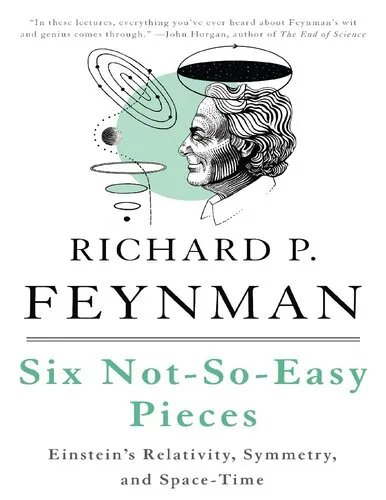
Six Not-So-Easy Pieces: Einstein’s Relativity, Symmetry, and Space-Time
Richard P. Feynman &Robert B. Leighton &Matthew Sands
2011
View book
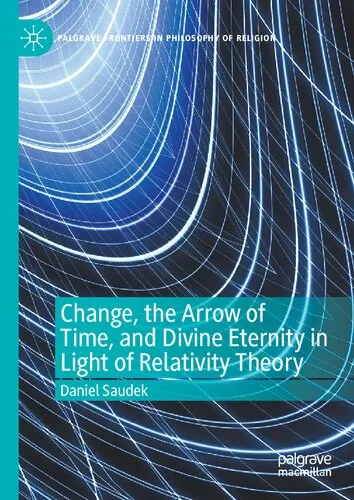
Book guide and evaluation
Daniel Saudek
0 reviews
Published
pages
views
Introduction Welcome to a thought-provoking exploration of time, change, and divine eternity viewed through the lens of contemporary physics. "Change, the Arrow of Time, and Divine Eternity in Light of Relativity Theory" delves into the philosophical impl
Before you read
Welcome to a thought-provoking exploration of time, change, and divine eternity viewed through the lens of contemporary physics. "Change, the Arrow of Time, and Divine Eternity in Light of Relativity Theory" delves into the philosophical implications of relativity and its impact on our understanding of time, reality, and the eternal. This book forms part of the 'Palgrave Frontiers in Philosophy of Religion' series, offering a refreshing take on age-old questions intertwined with modern scientific concepts.
The book begins by exploring the very foundations of time as understood in both classical and contemporary physics. It explains the concept of relativity theory, a crucial framework that revolutionizes how we perceive temporal order and the interconnectedness of events in the universe. With relativity, the past, present, and future are not as straightforward as once believed, compelling an evaluation of how we engage with the world and eternity.
From here, the discussion pivots to the philosophical ramifications of these scientific insights. Questions concerning the nature of change, whether it's real or an illusion, are addressed with rigorous argumentation. How does relativity challenge the traditional philosophical notion of the arrow of time? What implications do these challenges have for understanding divine eternity?
Saudek intricately balances the scales between science and religion, bridging the gap to ponder whether timelessness and change are mutually exclusive or compatible concepts within divine eternity. This synthesis of scientific exploration and philosophical contemplation encourages readers to critically consider not only the universe's temporal dimensions but the profound theological questions they raise.
"If time is relative, the consistency of its flow — what we have, until now, taken for granted as the steady arrow of time — is a dynamic we can no longer afford to overlook in our philosophical and theological quests."
"In romance as in physics, relativity teaches us that proximity and velocity are not merely math but the fundamental essence of reality's interaction with the eternal."
"Change, the Arrow of Time, and Divine Eternity in Light of Relativity Theory" is significant because it traverses uncharted territories between physics and metaphysics. The book facilitates a deeper understanding of how contemporary scientific theories enrich, complicate, and sometimes challenge traditional philosophical and theological perspectives. By offering a synthesis of science and spirituality, it invites readers to embrace an interdisciplinary approach that unveils the profound mysteries of existence.
In an era when scientific advancement continues to reshape our knowledge landscape, this work provides a crucial platform for intellectual reflection, encouraging philosophers, theologians, scientists, and lay readers to engage in dialogue that respects both empirical inquiry and spiritual reasoning. Ultimately, it fosters a deeper appreciation of the intertwined nature of physical laws and cosmic questions of purpose and meaning.
Your question is answered in the context of this title and author. Each answer uses 2 points.
0 reviews, 4.9 average out of 5
Sign in to publish a review.
Ask a focused question and learn from the community.
Related references that continue this learning path.
Richard P. Feynman &Robert B. Leighton &Matthew Sands