
Book guide and evaluation
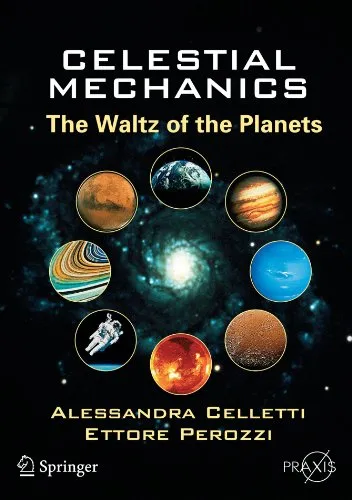
Celestial Mechanics
Alessandra Celletti,Ettore Perozzi
English
Beginner
Classical Mechanics
4.7 / 5
0 reviews
2007
Published
276
pages
528
views
Introduction to Celestial Mechanics Welcome to the fascinating world of 'Celestial Mechanics' by Alessandra Celletti and Ettore Perozzi, a comprehensive exploration of the dynamic cosmos that bridges the gap between the elegance of mathematics and the wonder of astronomy
Before you read
What will you get from this book?
Introduction to Celestial Mechanics
Welcome to the fascinating world of 'Celestial Mechanics' by Alessandra Celletti and Ettore Perozzi, a comprehensive exploration of the dynamic cosmos that bridges the gap between the elegance of mathematics and the wonder of astronomy. This book delves into the mechanics of heavenly bodies, offering readers a profound understanding of the underlying principles that govern their motions and behaviors.
Detailed Summary of the Book
The book 'Celestial Mechanics' serves as both an introductory text for newcomers to the field and a detailed resource for seasoned enthusiasts and academics. The authors unravel the complexities of celestial phenomena through a blend of mathematical rigor and practical insights. The initial chapters lay the groundwork, introducing fundamental concepts such as gravitation, orbits, and the two-body problem, essential for understanding any celestial system. As the book progresses, these foundational ideas are expanded upon with advanced topics like perturbation theories, resonances, and chaos in celestial systems, offering a well-rounded view of the celestial mechanics landscape.
The authors' approach is characterized by a careful buildup of concepts, ensuring that each chapter builds upon the last, equipped with illustrations and examples that illuminate the theories discussed. The reader is guided through planetary motion, satellite dynamics, and the intricate dance of the three-body problem, fostering a deeper appreciation for the wondrous universe we are a part of.
Key Takeaways
- Understanding the basic principles of gravitation and how they govern the motion of celestial bodies.
- Gaining insights into the mathematical models used to describe planetary orbits and their applications.
- Appreciating the role of chaos theory in predicting celestial events and the implications for space exploration.
- The importance of perturbation theories in understanding how small changes can affect large systems over time.
Famous Quotes from the Book
“The universe is a profound enigma, but with celestial mechanics, we begin to decipher the language of the stars.”
“In the dance of astronomical bodies, we find both chaos and harmony, a reflection of the cosmos itself.”
Why This Book Matters
'Celestial Mechanics' is more than a textbook; it is an invitation to explore the universe through the lens of physics and mathematics. This book matters because it equips readers with the tools to understand the universe's vastness and intricacies. By demystifying the mechanics governing celestial bodies, it bolsters our understanding of space exploration, satellite deployment, and climate modeling. Moreover, it inspires curiosity and wonder, encouraging readers to engage with the universe in new and meaningful ways. Whether you are a student, researcher, or hobbyist, this book offers invaluable insights that transcend traditional academic boundaries, resonating on a broader scale.
Ask this book
Your question is answered in the context of this title and author. Each answer uses 2 points.
Sign in to ask the book assistant.
Reader reviews
0 reviews, 4.7 average out of 5
No reviews yet
If you have read this book, help the next reader with your experience.
Write a review
Sign in to publish a review.
Reader questions and answers
Ask a focused question and learn from the community.
Sign in to ask or answer a question.
No questions yet
Be the first to ask a clear, useful question.
What to read next
Related references that continue this learning path.
Mechanics of the 21st century: proceedings of the 21st International Congress of Theoretical and Applied Mechanics, Warsaw, Poland, 15 - 21 August 2004
Tomasz A. Kowalewski (Editor) Witold Gutkowski (Editor)
2005
View book
An Introduction to the History of Structural Mechanics: Part II: Vaulted Structures and Elastic Systems
Edoardo Benvenuto (auth.)
1991
View book