

Book guide and evaluation
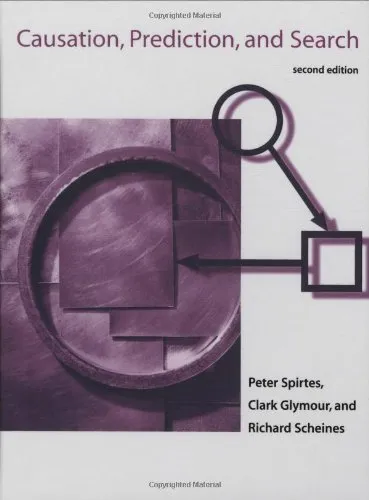
Causation, Prediction, and Search, Second Edition (Adaptive Computation and Machine Learning)
Peter Spirtes,Clark Glymour,Richard Scheines
English
Beginner
Software Engineering
4.8 / 5
0 reviews
2001
Published
567
pages
131
views
Causation, Prediction, and Search, Second Edition - An Introduction Written by Peter Spirtes, Clark Glymour, and Richard Scheines, Causation, Prediction, and Search, Second Edition, is a groundbreaking work exploring the intersection of causation, machine learning, and dat
Before you read
What will you get from this book?
Causation, Prediction, and Search, Second Edition - An Introduction
Written by Peter Spirtes, Clark Glymour, and Richard Scheines, Causation, Prediction, and Search, Second Edition, is a groundbreaking work exploring the intersection of causation, machine learning, and data analysis. This book stands as one of the most comprehensive texts for understanding the relationship between data and the causal structures generating them. Designed for researchers, practitioners, and anyone interested in causal modeling, this revised edition is an essential resource in artificial intelligence, machine learning, statistics, and philosophy.
Detailed Summary of the Book
The second edition of Causation, Prediction, and Search extends the thoughtful analysis and frameworks introduced in the first edition. It provides a cutting-edge guide to causal inference, delving into techniques and tools for understanding and predicting causal relationships from observed data. Unlike traditional statistical methods that often fail to reveal causation, this book explores advanced methodologies to distinguish correlation from causation.
The book begins with an in-depth discussion of causality, emphasizing its significance in the physical, social, and information sciences. It then introduces graphical models, which serve as intuitive and powerful representations of complex causal structures in empirical data. Through the use of directed acyclic graphs (DAGs) and Bayesian networks, readers can infer causal relationships from observational datasets. The authors discuss algorithms like the PC algorithm for causal structure discovery and provide a rigorous mathematical foundation.
A major focus of the book is computational tools for prediction and causal discovery in cases where the data is incomplete or contains measurement error. The authors explore the challenges and limitations of existing methods and present new innovations, backed by empirical research and theoretical insights. This work is particularly relevant for interdisciplinary studies, building bridges between computer science, philosophy, and applied statistics.
This edition also addresses contemporary debates in causal inference, integrating advancements in machine learning, including applications of causal models in artificial intelligence. Scholars and AI practitioners alike will appreciate its detailed exploration of nonparametric models and algorithms designed to scale with complex data.
Key Takeaways
- Deep understanding of the foundations of causation and its formal representation using graphical models.
- An introduction to algorithms like the PC algorithm and their role in causal structure discovery.
- Insights into challenges such as incomplete data, hidden variables, and measurement errors, along with potential solutions.
- Guidance on applying causal reasoning within machine learning and AI applications.
- Emphasis on interdisciplinary approaches, bridging gaps between sciences and computation.
After reading this book, readers will not only appreciate the theory underpinning causal inference but will also gain practical skills for applying these techniques to real-world problems.
Famous Quotes from the Book
"Correlation is not causation, but causation cannot be understood without correlation."
“The process of discovery begins with asking the right questions. In causality, the key is not just whether X affects Y, but why and how.”
“Understanding causation moves beyond prediction: it empowers us to act, intervene, and reason about consequences.”
Why This Book Matters
In an era dominated by vast quantities of data, understanding causation is more important than ever. Classical statistical tools often fall short in revealing the underlying causal mechanisms that drive observed phenomena. This book fills that gap by equipping readers with robust frameworks and computational algorithms to uncover causal relationships and improve predictive models.
The authors have written this book for a world increasingly reliant on data-driven decision-making, from healthcare and economics to machine learning and artificial intelligence. By offering both theoretical insights and practical guidelines, Causation, Prediction, and Search, Second Edition serves researchers and practitioners navigating the critical task of extracting causally-meaningful insights from data.
This work provides a bridge between academic studies and practical application, making it indispensable for data scientists, statisticians, machine learning engineers, and philosophers of science alike. For any individual or organization seeking to move beyond predictions to recommendations, interventions, and actionable insights, this book charts the course.
Ask this book
Your question is answered in the context of this title and author. Each answer uses 2 points.
Sign in to ask the book assistant.
Reader reviews
0 reviews, 4.8 average out of 5
No reviews yet
If you have read this book, help the next reader with your experience.
Write a review
Sign in to publish a review.
Reader questions and answers
Ask a focused question and learn from the community.
Sign in to ask or answer a question.
No questions yet
Be the first to ask a clear, useful question.
What to read next
Related references that continue this learning path.



Modern Computer Vision with PyTorch: A Practical Roadmap From Deep Learning Fundamentals to Advanced Applications and Generative AI, 2nd Edition
V Kishore Ayyadevara,Yeshwanth Reddy
2023
View book