
Book guide and evaluation
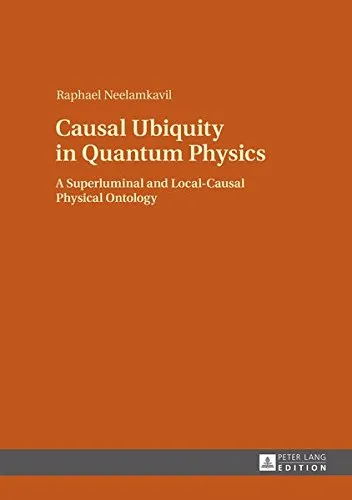
Causal Ubiquity in Quantum Physics: A Superluminal and Local-Causal Physical Ontology
Raphael Neelamkavil
English
Beginner
Art
4.2 / 5
0 reviews
2014
Published
364
pages
206
views
Introduction Quantum physics has fascinated and perplexed scientists for over a century, challenging our understanding of reality with its peculiar phenomena. My book, Causal Ubiquity in Quantum Physics: A Superluminal and Local-Causal Physical Ontology, seeks to unravel
Before you read
What will you get from this book?
Introduction
Quantum physics has fascinated and perplexed scientists for over a century, challenging our understanding of reality with its peculiar phenomena. My book, Causal Ubiquity in Quantum Physics: A Superluminal and Local-Causal Physical Ontology, seeks to unravel some of the mysteries surrounding quantum mechanics by presenting a fresh perspective rooted in both rigorous scientific reasoning and profound philosophical insights. This work explores the intersections of causality, superluminal communication, and the core tenets of quantum theory, offering readers a paradigm-shifting lens to understand the universe.
In this book, I introduce the concept of "Causal Ubiquity," a principle that seeks to reconcile the enigmatic behaviors observable in quantum systems with a logical, causally coherent framework. While quantum mechanics often implies nonlocal phenomena, seemingly at odds with the ideas of causality and locality, this book presents a comprehensive approach that not only addresses these disparities but does so with a commitment to scientific integrity and philosophical clarity. It is written for physicists, philosophers, and curious minds eager to explore deeper questions about the universe's fabric.
Detailed Summary of the Book
The book begins by establishing the foundational challenges in quantum mechanics, particularly those pertaining to nonlocality, entanglement, and superposition. Einstein's struggles with the idea of "spooky action at a distance" and Bell's theorems have historically framed quantum mechanics as a domain defying classical intuition. However, this work introduces a nuanced hypothesis: the ubiquity of causality, which postulates that every quantum process abides by a framework of superluminal yet local-causal interactions.
The narrative proceeds to describe an alternative physical ontology, which integrates the seemingly paradoxical events in quantum systems into a coherent model. This model upholds the inviolability of causality while allowing for faster-than-light communication that respects local realism. The key argument centers on the reinterpretation of quantum probabilities as reflections of underlying deterministic causal structures. This argument has profound implications for how we understand entanglement, wavefunction collapse, and the nature of measurement.
The book also delves into the broader implications of Causal Ubiquity, suggesting that it could unify quantum mechanics and relativity by preserving causality across scales. Through accessible language and detailed thought experiments, the book bridges the gap between scientific theory, experimental observations, and broader philosophical interpretations. By the conclusion, readers are left with a redefined appreciation for the principles underlying our universe, motivating further inquiry and critical thought.
Key Takeaways
- Causal Ubiquity offers a new perspective to reconcile the apparent violations of locality in quantum mechanics.
- Quantum phenomena such as entanglement and wavefunction collapse can be explained within a causally consistent framework.
- The book proposes that superluminal interactions are not at odds with causality but rather complement it within certain physical contexts.
- This framework challenges classical assumptions about determinism, probabilities, and quantum measurements while remaining scientifically rigorous.
Famous Quotes from the Book
"Causal ubiquity is not merely a principle of quantum mechanics; it is a fundamental attribute of reality, weaving together the tapestry of existence with threads of coherence."
"The universe does not play dice; it syncs them. Entanglement is not a puzzle but a mirror reflecting causality's deeper structure."
"The apparent contradictions in quantum mechanics are our illusions, born out of interpreting an unfamiliar world using familiar rules."
Why This Book Matters
This book matters because it addresses one of the most perplexing challenges in modern science: the reconciliation of quantum mechanics with classical notions of causality and locality. By proposing a groundbreaking framework, the book offers clarity and consistency to phenomena long viewed as paradoxical. It is a crucial resource not only for physicists seeking to navigate quantum mechanics' philosophical labyrinth but also for thinkers curious about the universe's deeper truths.
The principles outlined herein also pave the way for advancements in quantum technologies, including quantum computing and communication, by offering a structured interpretation of superluminal processes. Additionally, the book promotes interdisciplinary dialogue between physics, philosophy, and cosmology, encouraging new approaches to old problems.
In a period where scientific understanding continues to expand, Causal Ubiquity in Quantum Physics: A Superluminal and Local-Causal Physical Ontology serves as a beacon for those committed to uncovering the principles that govern reality. It invites readers to question, explore, and innovate, laying a foundation for the next era of scientific discovery.
Ask this book
Your question is answered in the context of this title and author. Each answer uses 2 points.
Sign in to ask the book assistant.
Reader reviews
0 reviews, 4.2 average out of 5
No reviews yet
If you have read this book, help the next reader with your experience.
Write a review
Sign in to publish a review.
Reader questions and answers
Ask a focused question and learn from the community.
Sign in to ask or answer a question.
No questions yet
Be the first to ask a clear, useful question.
What to read next
Related references that continue this learning path.


Modern Computer Vision with PyTorch: A Practical Roadmap From Deep Learning Fundamentals to Advanced Applications and Generative AI, 2nd Edition
V Kishore Ayyadevara,Yeshwanth Reddy
2023
View book