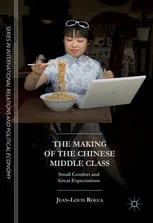
The Making of the Chinese Middle Class: Small Comfort and Great Expectations
Jean-Louis Rocca (auth.)
2017
View book
Book guide and evaluation
Yasheng Huang
0 reviews
Published
pages
views
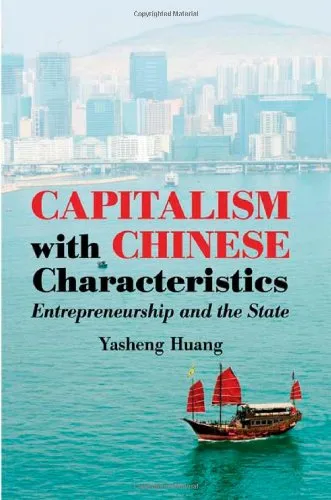
Introduction to 'Capitalism with Chinese Characteristics: Entrepreneurship and the State' "Capitalism with Chinese Characteristics: Entrepreneurship and the State" by Yasheng Huang offers an insightful exploration into the unique blend of capitalism that has propel
Before you read
"Capitalism with Chinese Characteristics: Entrepreneurship and the State" by Yasheng Huang offers an insightful exploration into the unique blend of capitalism that has propelled China's economic growth and helped position it as a global powerhouse. The book dives into the complex interplay between entrepreneurship and state intervention, shedding light on how Chinese economic policies fostered rapid development, the challenges encountered along the way, and how these dynamics contrast with Western capitalist models.
This book presents a nuanced analysis of China's economic transformation, focusing extensively on the elemental forces of entrepreneurship and state control. Yasheng Huang posits that the explosive growth of the Chinese economy since the late 1970s is not solely the product of state-led industrial policy, but a symbiotic relationship where entrepreneurship and state intervention coexist. He traces China's transformation from a predominantly agrarian economy to its current status as a leading global economic entity, emphasizing the regional and temporal variations in policies.
A key component of this transformation, as outlined by Huang, is the dynamism of small- and medium-sized enterprises, often rural, which innovated and expanded in a regulatory environment initially more conducive to private ownership and enterprise than many observers appreciated. The author critically examines shifts in policy dynamics over different eras, with extensive qualitative and quantitative data from regional levels, providing a contrast between the pre- and post-1990s economic environments in China.
Huang expertly highlights the role of indigenous private entrepreneurship, citing instances where policy environments favored local development and entrepreneurship, leading to innovations that significantly impacted the growth trajectory. The book artfully critiques some misconceptions about the Chinese growth story, challenging the conventional wisdom that China's explosive economic growth was solely due to state-directed capitalism.
"True economic development in China has often relied on a powerful alliance between entrepreneurial traits and a state that knows when to step back."
"The regionally uneven pace of reforms reveals a tale of local dynamism combining with permissive policies to propel growth."
"Capitalism with Chinese Characteristics" is a pivotal work for anyone looking to understand the finer details of China’s economic surge and its implications for global economics. With the rise of China as an economic superpower, it becomes essential to comprehend how it managed to accomplish such an astonishing economic transformation. This book provides critical insights into how local entrepreneurship combined with prudent state intervention to facilitate growth, offering lessons on economic policy that extend beyond China's borders.
Huang's analysis helps debunk several myths about China's growth strategy and underlines the relevance of entrepreneurship even within a state-controlled framework. For policymakers, economists, and business leaders, the book serves as both a historical account and a strategic guide for understanding and engaging with China’s unique business environment.
Your question is answered in the context of this title and author. Each answer uses 2 points.
0 reviews, 4.8 average out of 5
Sign in to publish a review.
Ask a focused question and learn from the community.
Related references that continue this learning path.
Jean-Louis Rocca (auth.)