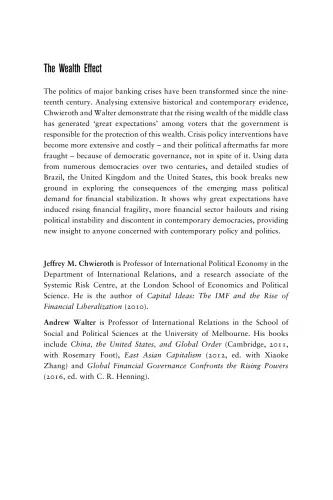
The Wealth Effect: How The Great Expectations Of The Middle Class Have Changed The Politics Of Banking Crises
Chwieroth, Jeffrey M.;Walter, Andrew
2019
View book
Book guide and evaluation
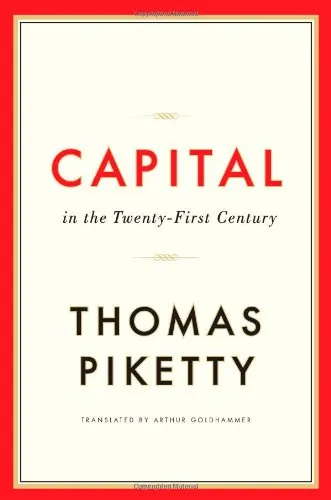
Thomas Piketty,Arthur Goldhammer
0 reviews
Published
pages
views
Introduction to Capital in the Twenty-First Century Welcome to an exploration of economic history through the lens of capitalism's evolution and its impact on contemporary society. "Capital in the Twenty-First Century," authored by Thomas Piketty and translated by Arthur G
Before you read
Welcome to an exploration of economic history through the lens of capitalism's evolution and its impact on contemporary society. "Capital in the Twenty-First Century," authored by Thomas Piketty and translated by Arthur Goldhammer, critically examines the dynamics of wealth and income inequality both historically and in modern times. Through rigorous analysis and empirical data, Piketty uncovers important insights about how wealth distribution has shaped and will continue to shape the economic landscape.
"Capital in the Twenty-First Century" embarks on a comprehensive journey through three centuries of economic history, scrutinizing the fundamental forces that govern capital and inequality. Piketty presents an in-depth narrative supported by extensive data collection from multiple countries, particularly focusing on Europe and the United States. His central thesis revolves around the idea that when the rate of return on capital (r) exceeds the growth rate of the economy (g), wealth inequality tends to increase. This phenomenon has been observable historically and is currently exacerbating disparities.
Delving into the historical data, Piketty illustrates how the structure of wealth has shifted through periods such as the industrial revolution, the post-World War II era, and the neoliberal resurgence of the late twentieth century. Capital accumulation, inheritance, and the interplay with technological advances are key themes discussed. Piketty also emphasizes policy interventions and the role of globalization in redistributing economic gains.
"When the rate of return on capital exceeds the rate of growth of output and income, as it did in the nineteenth century and seems quite likely to do again in the twenty-first, capitalism automatically generates arbitrary and unsustainable inequalities that radically undermine the meritocratic values on which democratic societies are based."
"The history of inequality is shaped by the way economic, social, and political actors view what is just and what is not, as well as by the relative power of those actors and the collective choices that result."
"Capital in the Twenty-First Century" is an essential read for anyone interested in understanding the evolving dynamics of wealth distribution and its broader societal impact. Piketty's work stands out for its meticulous research, offering fresh perspectives on economic inequalities while challenging existing paradigms. It serves as both a warning about unchecked economic disparities and a call to action for more equitable economic policies. By anchoring the analysis in historical context and empirical evidence, Piketty provides invaluable insights into potential paths toward a more balanced and just world economy.
Your question is answered in the context of this title and author. Each answer uses 2 points.
0 reviews, 4.0 average out of 5
Sign in to publish a review.
Ask a focused question and learn from the community.
Related references that continue this learning path.
Chwieroth, Jeffrey M.;Walter, Andrew