
Self-focusing: Past and Present: Fundamentals and Prospects
Y. Ron Shen (auth.),Robert W. Boyd,Svetlana G. Lukishova,Y.R. Shen (eds.)
2009
View book
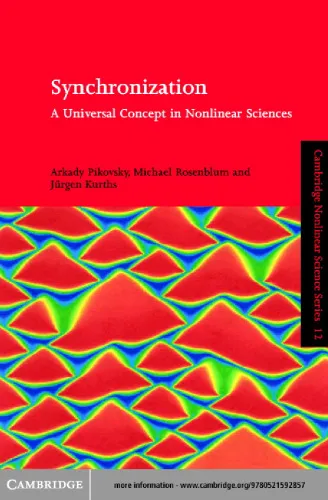
Book guide and evaluation
Arkady Pikovsky, Michael Rosenblum, Jurgen Kurths
0 reviews
Published
pages
views
Cambridge Nonlinear Science Series 12 nonlinear dynamics, complex systems Explore Cambridge Nonlinear Science Series 12, a profound study of nonlinear dynamics and complex systems in modern scientific research. Analytical Summary The Cambridge Nonlinear Science Se
Before you read
The Cambridge Nonlinear Science Series 12 stands as a rigorous and insightful volume in one of the most respected academic series devoted to the study of nonlinear dynamics and complex systems. Authored by Arkady Pikovsky, Michael Rosenblum, and Jürgen Kurths, this book synthesizes years of dedicated research into a cohesive work that bridges theory and application.
This installment offers an in-depth examination of synchronization phenomena occurring in diverse natural and engineered systems. While the specific publication year is “Information unavailable” due to the absence of reliable public sources, the work itself has remained a relevant cornerstone for both seasoned researchers and emerging scholars in applied mathematics, physics, engineering, and computational science.
The narrative traverses the intricate mathematical models that describe coupled oscillators, the multifaceted behaviors arising from nonlinear interactions, and the analytical tools that have evolved to tackle such complexity. Highly mathematical yet lucidly explained, it invites a serious reader to delve into the nature of coherence and order amidst chaos—a subject pivotal in disciplines ranging from neuroscience to climate science.
By situating its discourse within the wider context of contemporary scientific inquiry, Cambridge Nonlinear Science Series 12 not only educates but also challenges the reader to see beyond the abstractions, prompting reflection on the real-world systems these principles illuminate.
Readers will emerge from this book with a robust conceptual and mathematical framework for understanding synchronization and nonlinear pattern formation.
One central takeaway is the universality of nonlinear dynamics as a language for describing a wide array of systems, from pendulum arrays to neural networks.
Another is the importance of coupling strength, delay, and topology in shaping collective behaviors. The book emphasizes that complex systems often reveal simple emergent laws when examined through the correct analytical lens.
The exposition also makes clear that interdisciplinary collaboration enhances our ability to tackle nonlinear challenges—it bridges mathematics with physical and biological sciences.
Finally, it underscores the value of combining numerical simulation with analytical methods to validate hypotheses and explore conditions beyond straightforward derivation.
"Synchronization is the melody woven into the noise, the rhythm that emerges from disorder." Unknown
"In the realm of nonlinear dynamics, small changes can cascade into majestic patterns." Unknown
"The coupling of systems is not merely an interaction—it is a dialogue that shapes reality." Unknown
In a world increasingly defined by interconnected systems, deep comprehension of nonlinear science is no longer optional—it is essential.
The Cambridge Nonlinear Science Series 12 equips scientists and engineers with the language, tools, and interpretive frameworks needed to make sense of complexities underlying modern phenomena. By demystifying synchronization, it provides actionable insight relevant to communication technology, biomedical research, climate modeling, and beyond.
For academia, it serves as a high-level teaching resource. For professionals, it can be a reference guide underpinning applied innovations. Its combination of mathematical rigor and accessibility helps bridge a gap often found between theoretical science and practical application.
The Cambridge Nonlinear Science Series 12 is more than a textbook; it is a lens through which one can view the hidden synchronies of our universe.
It offers not only theoretical mastery but also practical perspective—the keys to unlocking patterns in the seemingly unpredictable. Whether you are an academic seeking deeper knowledge, a professional aiming to apply nonlinear models, or simply a curious mind drawn to the elegance of scientific order, this book provides a path forward.
We invite you to read, share, and discuss the insights contained herein. In doing so, you become part of the ongoing conversation about how complexity is understood and harnessed—not just in the laboratory, but in the systems that define our daily lives.
Your question is answered in the context of this title and author. Each answer uses 2 points.
0 reviews, 4.8 average out of 5
Sign in to publish a review.
Ask a focused question and learn from the community.
Related references that continue this learning path.
Y. Ron Shen (auth.),Robert W. Boyd,Svetlana G. Lukishova,Y.R. Shen (eds.)
Sarah Abdulla, Christopher Clarke
