Book guide and evaluation
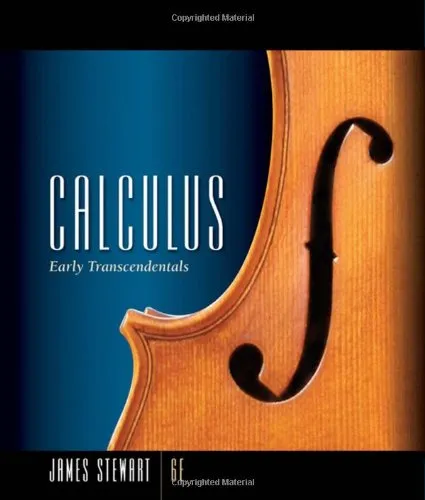
Calculus: Early Transcendentals
James (James Stewart) Stewart
English
Beginner
Mathematical Analysis
4.7 / 5
0 reviews
2007
Published
1308
pages
535
views
Introduction to Calculus: Early Transcendentals Welcome to the fascinating world of calculus, where abstract concepts meet practical applications, giving life to problems that shape our understanding of the physical world. "Calculus: Early Transcendentals" is a comprehensi
Before you read
What will you get from this book?
Introduction to Calculus: Early Transcendentals
Welcome to the fascinating world of calculus, where abstract concepts meet practical applications, giving life to problems that shape our understanding of the physical world. "Calculus: Early Transcendentals" is a comprehensive guide designed for students and educators alike, providing an engaging platform to explore the foundational principles of calculus and its far-reaching implications.
Detailed Summary of the Book
The book "Calculus: Early Transcendentals" delves deep into the essentials of calculus, starting with a firm base in functions and models, followed by the intricacies of limits and derivatives. As students progress, they encounter applications of differentiation, integrals, and their applications, ultimately transitioning into more advanced topics like sequences, series, and vector calculus. The 'early transcendentals' approach ensures that transcendental functions are introduced early in the course, providing a comprehensive view that integrates these vital concepts throughout the learning process.
One of the book's strengths is its structured methodology, balancing clarity with rigor. Each chapter is designed to build on students' existing knowledge while challenging them to think critically. Plenty of examples, solved problems, and exercises serve as practical guides, allowing students to master concepts through practice. Complex mathematical theories are simplified through intuitive explanations and visual aids, making the intense study of calculus approachable and satisfying.
Key Takeaways
Readers of "Calculus: Early Transcendentals" gain numerous skills and insights, including:
- A strong understanding of functions, limits, derivatives, and integrals, and their applications in real-world scenarios.
- The ability to solve complex mathematical problems and develop critical thinking skills needed for advanced mathematics and related fields.
- An appreciation for the beauty and utility of calculus in various disciplines, from engineering to physics, and beyond.
- Enhanced problem-solving techniques and strategies through a variety of exercises tailored to different learning levels.
Famous Quotes from the Book
Insightful quotes from the book capture the essence and excitement of learning calculus:
"Calculus can unlock the mysteries of the universe, laying bare the patterns woven into the tapestry of reality."
"In each limit and derivative, we uncover the profound relationships and interconnections that underpin the physical world."
Why This Book Matters
"Calculus: Early Transcendentals" stands out not just for its content but also for the impact it has made in educational environments worldwide. Its clear and thoughtful exposition helps demystify calculus, making it accessible to a wide audience. The book has been instrumental in shaping modern calculus education, serving as a primary resource in classrooms around the globe.
The careful integration of technology, such as graphing utilities, alongside traditional problem-solving methods, provides students with varied approaches to learning. Its focus on preparing students for the challenges of STEM fields has made it a trusted companion for aspiring scientists and engineers.
Whether used as a classroom text or a self-study guide, "Calculus: Early Transcendentals" offers a thorough foundation, equipping learners with the tools needed to advance confidently into the future of mathematics and its applications in our ever-evolving world.
Ask this book
Your question is answered in the context of this title and author. Each answer uses 2 points.
Sign in to ask the book assistant.
Reader reviews
0 reviews, 4.7 average out of 5
No reviews yet
If you have read this book, help the next reader with your experience.
Write a review
Sign in to publish a review.
Reader questions and answers
Ask a focused question and learn from the community.
Sign in to ask or answer a question.
No questions yet
Be the first to ask a clear, useful question.
What to read next
Related references that continue this learning path.
Integral, Measure and Derivative: A Unified Approach
G. E. Shilov,B. L. Gurevich
1977/2012
View book
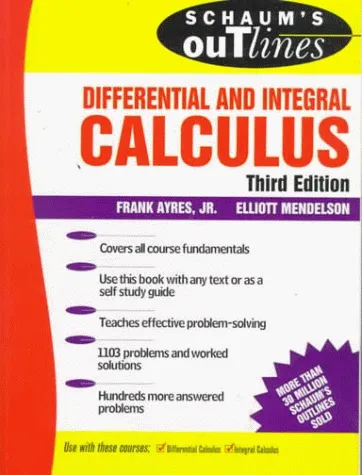
Schaum's outline of theory and problems of differential and integral calculus
Frank Ayres,Elliott Mendelson
1990
View book