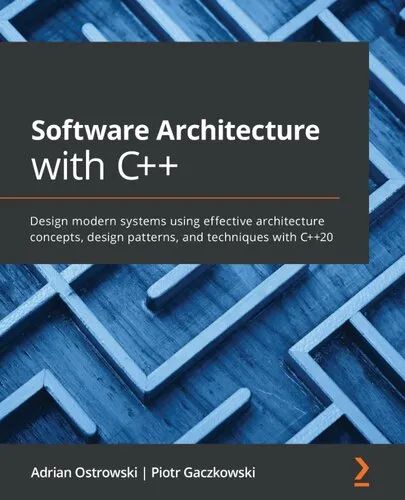
Software Architecture with C++ - Design modern systems using effective architecture concepts, design patterns, and techniques with C++20
Adrian Ostrowski,Piotr Gaczkowski
2021
View book
Book guide and evaluation
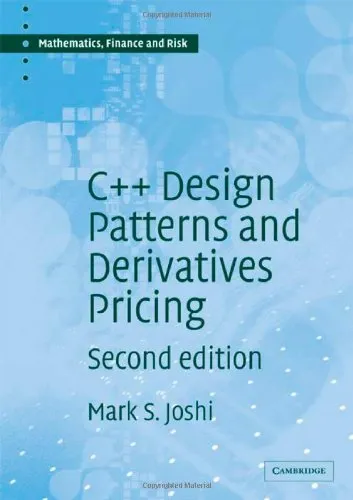
M. S. Joshi
0 reviews
Published
pages
views
Introduction Welcome to 'C++ Design Patterns and Derivatives Pricing (Mathematics, Finance and Risk)', a comprehensive guide that bridges the gap between software engineering and financial mathematics. Authored by M. S. Joshi, this book stands as a detailed resourc
Before you read
Welcome to 'C++ Design Patterns and Derivatives Pricing (Mathematics, Finance and Risk)', a comprehensive guide that bridges the gap between software engineering and financial mathematics. Authored by M. S. Joshi, this book stands as a detailed resource for financial engineers, quantitative analysts, and software developers interested in understanding the intricate world of derivatives pricing through efficient C++ programming techniques, augmented with powerful design patterns.
This book delves deep into the application of C++ design patterns specifically tailored to the domain of financial derivatives. It starts by elucidating the foundational concepts of financial derivatives, providing readers a solid grounding in derivatives' core principles. The narrative then transitions to the intricacies of C++ programming, emphasizing how modern design patterns can be leveraged to solve complex problems in derivative pricing efficiently.
Each chapter methodically builds on its predecessor, introducing concepts such as option pricing, Monte Carlo methods, and lattice models while demonstrating their implementation using C++. The synergistic approach not only enhances the coder's skills but also deepens the understanding of financial concepts. M. S. Joshi meticulously dissect complex models into understandable modules implemented through well-structured C++ code, enriched by examples and exercises to reinforce learning.
"Code is not just an artifact of invoking a machine response, but a structured narrative of complex financial landscapes."
"In the realm of financial derivatives, models are as strong as their implementations — and that demands clarity in both thought and code."
In the rapidly evolving intersection of finance and technology, M. S. Joshi's 'C++ Design Patterns and Derivatives Pricing' is an indispensable contribution to the field of quantitative finance. With the precision of a seasoned expert, Joshi distills years of industry experience into an accessible guide that empowers financial and software professionals alike. As the financial world continues to demand robust, scalable solutions, understanding how to effectively deploy C++ for financial models becomes crucial.
This book not only equips readers with the technical know-how but also fosters a deeper appreciation of the mathematics underlying derivative products. In an industry where efficiency and precision are paramount, Joshi provides the tools needed to excel, making this book a quintessential read for those aiming to master the art of financial engineering through the lens of C++.
Your question is answered in the context of this title and author. Each answer uses 2 points.
0 reviews, 4.5 average out of 5
Sign in to publish a review.
Ask a focused question and learn from the community.
Related references that continue this learning path.
Adrian Ostrowski,Piotr Gaczkowski