

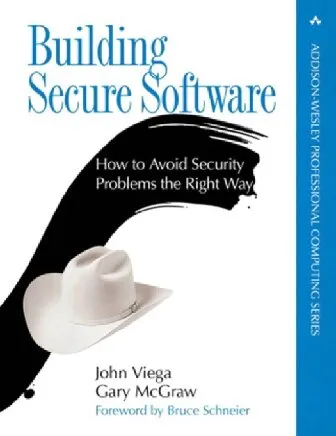
Book guide and evaluation
Building secure software: how to avoid security problems the right way
John Viega,Gary McGraw.
English
Beginner
Software Engineering
4.3 / 5
0 reviews
2002
Published
526
pages
178
views
Introduction to Building Secure Software: How to Avoid Security Problems the Right Way In the modern era of software development, security is no longer a luxury—it’s a necessity. Building Secure Software: How to Avoid Security Problems the Right Way, written by John Viega an
Before you read
What will you get from this book?
Introduction to Building Secure Software: How to Avoid Security Problems the Right Way
In the modern era of software development, security is no longer a luxury—it’s a necessity. Building Secure Software: How to Avoid Security Problems the Right Way, written by John Viega and Gary McGraw, is a cornerstone reference for professionals aiming to build reliable and secure applications from the ground up. This book lays a strong foundation for understanding how to identify, prevent, and mitigate security risks during the software development lifecycle. It brings forth insights designed to help developers, managers, and security professionals align their work with best practices in cybersecurity.
Security breaches can devastate an organization’s reputation, erode trust, and result in extensive financial loss. Understanding how to address vulnerabilities and implement strong security measures during the development process is essential for creating software that is both functional and robust. Through real-world examples, expert insights, and actionable advice, Viega and McGraw bridge the gap between software development and secure design. Whether you are a seasoned software engineer or just stepping into the field, this book equips you with knowledge to fortify your applications against both common and complex security attacks.
Detailed Summary of the Book
At the heart of Building Secure Software is the premise that security must be baked into software, not bolted on after development is complete. The authors argue that treating security as an afterthought is one of the biggest mistakes developers make, and this book provides a structured methodology for preventing such errors. Spanning several chapters, the book meticulously explores the ways in which software vulnerabilities emerge, how attackers exploit them, and what can be done to prevent these issues.
The book emphasizes the importance of threat modeling, secure coding principles, and design strategies that prioritize security. It offers guidance on specific programming practices, like input validation, proper error handling, and managing buffer overflows. Additionally, it discusses secure architecture design and the importance of adhering to the principle of "least privilege" in systems. The authors delve into various categories of common vulnerabilities, including injection attacks, cross-site scripting, and race conditions. Each topic is addressed with precision, supported by concrete examples, and complemented with practical advice.
Furthermore, the book critiques the software industry’s tendency to value features and speed of development over security. It advocates for a shift in mindset—encouraging software professionals to view security as a critical, non-negotiable component of quality software engineering. With its holistic approach, this book equips readers with not only the technical tools but also the philosophical understanding necessary to integrate security into every project.
Key Takeaways
- Security must be integrated into the design and development process from the very beginning.
- Understanding secure coding practices is essential to preventing common vulnerabilities like buffer overflows, injection attacks, and race conditions.
- Threat modeling and risk assessment are crucial for identifying potential attack vectors and prioritizing mitigation efforts.
- Good security practices include input validation, proper error handling, and maintaining the principle of least privilege.
- Educating software developers and creating a culture of security awareness is as important as technical skills.
Famous Quotes from the Book
"Security is not a product; it’s a process."
"The biggest mistake that software developers make is assuming that attackers think like programmers."
Why This Book Matters
In an era where software lies at the core of everything from personal devices to critical infrastructure, the importance of building secure applications cannot be overstated. Building Secure Software is a timeless resource for anyone involved in the software development process. Unlike many security books that focus on post-development patching or ethical hacking, this book takes a proactive approach to security, addressing issues at their root.
The book's emphasis on practical solutions makes it accessible to engineers, project managers, and even business stakeholders. It not only teaches you the "how" of secure development but also the "why," enabling readers to think like attackers and understand the implications of their design choices. This makes the book not only a technical manual but also a call to action for the industry to prioritize software security at all levels.
If you care about designing software that can stand up to relentless cyber threats while earning trust from users, Building Secure Software is an essential addition to your library.
Ask this book
Your question is answered in the context of this title and author. Each answer uses 2 points.
Sign in to ask the book assistant.
Reader reviews
0 reviews, 4.3 average out of 5
No reviews yet
If you have read this book, help the next reader with your experience.
Write a review
Sign in to publish a review.
Reader questions and answers
Ask a focused question and learn from the community.
Sign in to ask or answer a question.
No questions yet
Be the first to ask a clear, useful question.
What to read next
Related references that continue this learning path.


Modern Computer Vision with PyTorch: A Practical Roadmap From Deep Learning Fundamentals to Advanced Applications and Generative AI, 2nd Edition
V Kishore Ayyadevara,Yeshwanth Reddy
2023
View book