
Book guide and evaluation
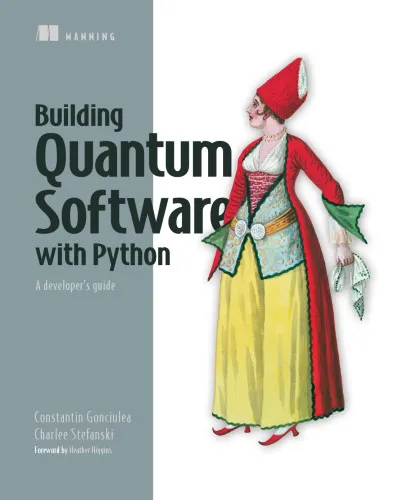
Building Quantum Software in Python: A developer's guide
Charlee Stefanski
English
Unordered
Artificial Intelligence (AI)
4.9 / 5
0 reviews
2025
Published
378
pages
272
views
Building Quantum Software in Python: A developer's guide Quantum computing development, Python programming for quantum applications Building Quantum Software in Python: A developer's guide empowers developers to create efficient quantum solutions with Python. Analyti
Before you read
What will you get from this book?
Analytical Summary
In the rapidly evolving landscape of quantum computing, Building Quantum Software in Python: A developer's guide stands as a meticulous, structured resource for developers, researchers, and academics who aim to bridge theoretical quantum mechanics with practical Python programming. This authoritative book delivers clear guidance on constructing, simulating, and optimizing quantum algorithms using modern Python libraries and tools.
It aligns foundational quantum concepts—like qubits, quantum gates, and entanglement—with Pythonic constructs in a way that is approachable for experienced coders yet rigorous enough for computer science professionals. By examining both the principles and the hands-on implementation of quantum algorithms, readers gain not only sequential knowledge but also a holistic understanding necessary for successful quantum software development.
Information unavailable regarding its official publication year; no reliable public source currently indicates the exact release date, yet its topical relevance in contemporary computing is evident. The text methodically moves from explaining quantum fundamentals to demonstrating state-of-the-art frameworks such as Qiskit, Cirq, and other Python-based interfaces to quantum processors.
Key Takeaways
The book’s blend of theoretical depth and applied coding strategies equips readers with practical competencies to design and test real quantum applications. This benefits both those transitioning from classical software engineering to quantum paradigms and academic researchers expanding their computational toolkit.
Mastering core quantum operations in Python fosters the ability to prototype algorithms that may run on cloud-based quantum processors, enabling scalable experimentation without dedicated hardware. Readers will appreciate the balance between mathematical precision and code-level clarity, making complex concepts tangible.
Another takeaway is the integration of Python’s data science ecosystem with quantum simulations, allowing hybrid approaches that leverage classical analysis pipelines alongside quantum processing units.
Memorable Quotes
"In quantum computing, understanding the math is only half the journey; learning to implement it in a language like Python completes the bridge." Unknown
"Python's clarity and versatility make it the ideal companion for translating quantum theory into working algorithms." Unknown
"Quantum computing will redefine software engineering; this book helps you prepare for that transformation." Unknown
Why This Book Matters
As quantum computing graduates from experimental labs into practical deployment, the necessity for accessible, robust educational materials grows ever more pressing. This book meets that demand with precision and pedagogical foresight.
Its relevance extends to software engineers aiming to future-proof their skills, scientists modeling quantum phenomena, and technologists seeking cross-disciplinary fluency. In particular, the synergy between quantum computing development and Python programming for quantum applications reflects a timely convergence of two powerful computing currents.
In the absence of a broad public curriculum in quantum programming, texts like this serve as both self-learning guides and formal references. They demystify the quantum execution model and ground abstract ideas in reproducible, executable Python code. This democratization of quantum computing knowledge is vital for widening participation in an emerging technological revolution.
Inspiring Conclusion
The journey mapped in Building Quantum Software in Python: A developer's guide is as much about mastering a new computing paradigm as it is about embracing the potential future of technology. By guiding readers through conceptual frameworks and practical implementations, the book equips them to participate actively in the quantum era.
If you are serious about staying ahead in the world of computing, exploring the interplay between quantum mechanics and Python is a decisive step. This book provides that conduit, offering structured insight, applicable techniques, and the confidence to innovate.
Invest in your understanding today—read, share, and discuss Building Quantum Software in Python: A developer's guide. The next generation of computation is unfolding, and with the right preparation, you can be more than just a witness—you can be a pioneer.
Ask this book
Your question is answered in the context of this title and author. Each answer uses 2 points.
Sign in to ask the book assistant.
Reader reviews
0 reviews, 4.9 average out of 5
No reviews yet
If you have read this book, help the next reader with your experience.
Write a review
Sign in to publish a review.
Reader questions and answers
Ask a focused question and learn from the community.
Sign in to ask or answer a question.
No questions yet
Be the first to ask a clear, useful question.
What to read next
Related references that continue this learning path.
Developing Apps with GPT-4 and ChatGPT: Build Intelligent Chatbots, Content Generators, and More, 2nd Edition
Olivier Caelen,Marie-Alice Blete
2024
View book