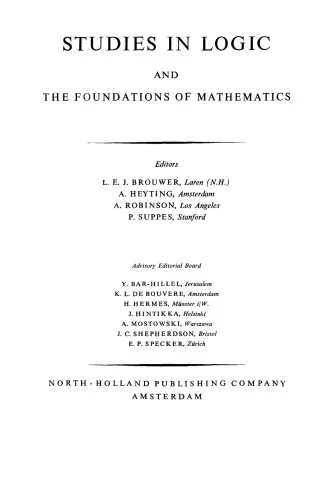
Formal Systems and Recursive Functions: Proceedings of the Eighth Logic Colloquium, Oxford, July 1963
John N. Crossley,Michael Dummett (editors)
1965
View book
Book guide and evaluation
Jan Krajicek
0 reviews
Published
pages
views
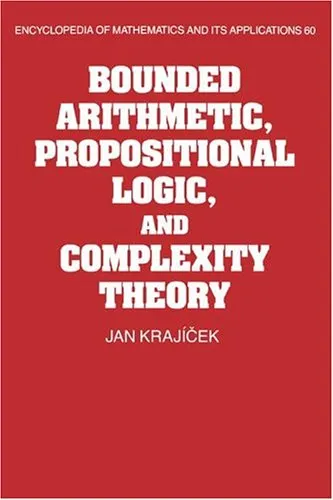
Introduction Welcome to an extensive exploration of the intersections between bounded arithmetic, propositional logic, and complexity theory. This book is part of the Encyclopedia of Mathematics and its Applications series, aiming to advance understanding in th
Before you read
Welcome to an extensive exploration of the intersections between bounded arithmetic, propositional logic, and complexity theory. This book is part of the Encyclopedia of Mathematics and its Applications series, aiming to advance understanding in these pivotal areas of mathematical logic and computational complexity.
The book delves deep into the study of bounded arithmetic, a fascinating branch of mathematical logic that deals with theories of arithmetic characterized by limits on quantifiers. These restrictions allow for the development of a rich yet manageable framework for understanding the computational complexity of arithmetic calculations. Through a comprehensive treatise, the book intricately ties these concepts to propositional logic and complexity theory.
In propositional logic, the text explores the relationships between logical proof systems and computational efficiency. It examines cutting-edge techniques in deriving minimal proof lengths and connecting these insights to broader complexity-theoretic concerns. By analyzing specific logical systems, the book highlights how these systems can model various aspects of polynomial time computations.
Complementing this, the book addresses critical questions in complexity theory, such as the nature of NP-completeness and the formidable P vs. NP problem. Readers will discover how bounded arithmetic offers novel insights into these topics, providing theoretical tools that can potentially reshape ongoing debates and research directions in computational complexity.
The author, Jan Krajíček, adopts a methodical approach to explicate complex mathematical phenomena, ensuring that each concept builds progressively towards a robust framework for understanding these interconnected domains.
"The elegance of bounded arithmetic lies in its capacity to mirror the complexities of computation within a logically constrained framework."
"In the vast landscape of propositional logic, one finds the keys to unlocking myriad computational secrets."
"Complexity theory, with its intricate puzzles, invites us to explore the very limits of what can be computed."
This book is pivotal for both students and researchers in mathematics, computer science, and logic due to its comprehensive analysis and clear exposition of complex topics. It enriches the reader's understanding of how discrete mathematics interfaces with theoretical computer science.
Furthermore, the work's examination of bounded arithmetic provides an invaluable perspective for those interested in the logical foundations of complexity theory. By offering new insights and methodologies, the book contributes significantly to ongoing discussions in logical theory and its computational applications.
The exploration of these subjects is not merely academic; the insights gained here have practical implications in algorithm design, cryptography, and beyond. As computational problems grow in importance and complexity, this book serves as a vital resource for those looking to deepen their grasp of the logical structures underpinning modern computation.
Your question is answered in the context of this title and author. Each answer uses 2 points.
0 reviews, 4.3 average out of 5
Sign in to publish a review.
Ask a focused question and learn from the community.
Related references that continue this learning path.
John N. Crossley,Michael Dummett (editors)