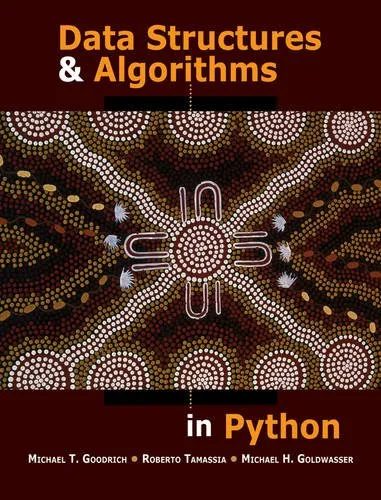
Data Structures and Algorithms in Python
Michael T. Goodrich,Roberto Tamassia,Michael H. Goldwasser
2013
View book
Book guide and evaluation
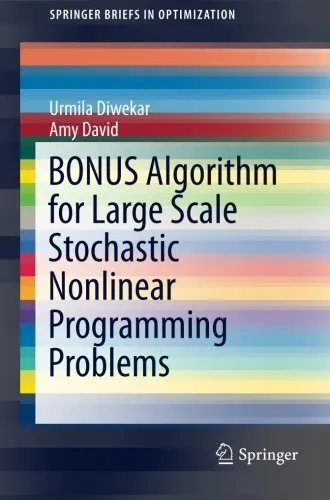
Urmila Diwekar,Amy David
0 reviews
Published
pages
views
Introduction to "BONUS Algorithm for Large Scale Stochastic Nonlinear Programming Problems" The ability to solve large-scale stochastic nonlinear programming (SNLP) problems is a cornerstone of modern scientific computing and optimization. In the book "BONUS Algorithm for
Before you read
The ability to solve large-scale stochastic nonlinear programming (SNLP) problems is a cornerstone of modern scientific computing and optimization. In the book "BONUS Algorithm for Large Scale Stochastic Nonlinear Programming Problems", authors Urmila Diwekar and Amy David present a groundbreaking and systematic methodology to address these complex problems using the BONUS algorithm. This book is a vital contribution to the fields of optimization, applied mathematics, and computational engineering, offering insights that extend beyond theoretical foundations and directly translate into practical applications.
Nonlinear problems involving uncertainties are pervasive in many disciplines, from energy systems and environmental modeling to financial risk analysis and operations research. Traditionally, tackling such problems has posed significant challenges due to their computational complexity and unpredictability. However, the BONUS (Better Optimization of Nonlinear Uncertain Systems) algorithm, as detailed in this book, provides a robust, scalable, and efficient approach to handle these intricacies.
This book is designed not only for researchers and professionals working directly in optimization but also for students, academics, and industry practitioners seeking to understand the nuances of stochastic nonlinear programming in real-world settings. With a focus on algorithmic innovation, practical implementation, and case-study driven insights, this book is an essential guide to unlocking the potential of the BONUS algorithm for solving some of the most demanding optimization problems of our time.
The book extensively explores the theoretical underpinnings, computational details, and real-world applications of the BONUS algorithm. The following topics are covered in-depth:
Throughout the book, the authors emphasize the balance between theory and application, ensuring that readers not only understand the algorithm but can also apply it effectively in solving real-world problems. The steps toward implementing the BONUS algorithm are meticulously outlined, making it accessible even to readers new to the field of stochastic nonlinear programming.
By the end of the book, readers will have gained the following insights:
"Optimization is not merely about finding solutions; it is about enabling systems to perform at their very best, even in the face of uncertainty."
"The BONUS algorithm redefines the boundaries of stochastic nonlinear programming by blending rigor with adaptability."
The significance of this book lies in its ability to bridge the gap between theory and practical application in the realm of large-scale optimization. The BONUS algorithm is a pivotal innovation that has been designed to address the perennial challenges of uncertainty, scalability, and computational complexity associated with stochastic nonlinear programming:
In summary, "BONUS Algorithm for Large Scale Stochastic Nonlinear Programming Problems" is not just a book but a critical resource for anyone looking to advance their knowledge and skills in optimization under uncertainty. It stands as a testament to the power of mathematical innovation to solve real-world problems, paving the way for a more efficient and resilient future.
Your question is answered in the context of this title and author. Each answer uses 2 points.
0 reviews, 3.5 average out of 5
Sign in to publish a review.
Ask a focused question and learn from the community.
Related references that continue this learning path.
Michael T. Goodrich,Roberto Tamassia,Michael H. Goldwasser
Narasimha Karumanchi