
Book guide and evaluation
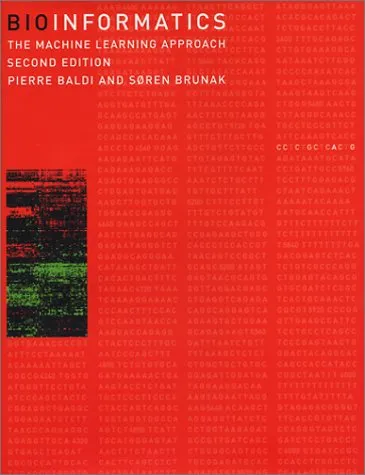
Bioinformatics: The Machine Learning Approach, Second Edition (Adaptive Computation and Machine Learning)
Pierre Baldi,Søren Brunak
English
Beginner
Machine Learning
4.5 / 5
0 reviews
2001
Published
477
pages
238
views
Introduction to "Bioinformatics: The Machine Learning Approach, Second Edition" Discover the groundbreaking integration of biology and computational intelligence in "Bioinformatics: The Machine Learning Approach, Second Edition." Authored by Pierre Baldi and Søren Brunak
Before you read
What will you get from this book?
Introduction to "Bioinformatics: The Machine Learning Approach, Second Edition"
Discover the groundbreaking integration of biology and computational intelligence in "Bioinformatics: The Machine Learning Approach, Second Edition." Authored by Pierre Baldi and Søren Brunak, this book provides a thoughtful, comprehensive, and scientifically rigorous exploration of how machine learning methodologies enhance our understanding of biological systems. As a cornerstone in the Adaptive Computation and Machine Learning series, this edition emphasizes practical implementations of computational algorithms, making it an indispensable resource for students, researchers, and professionals in bioinformatics, computer science, and biology.
Summary of the Book
This second edition delves deep into the intersection of machine learning and bioinformatics, offering updated insights into the rapidly evolving field of computational biology. The book opens by laying the foundational principles of machine learning and progresses toward their sophisticated applications in analyzing biological data. Topics such as sequence alignment, genetic analysis, structural prediction, and data mining are thoroughly discussed, with each chapter emphasizing clarity, depth, and relevance.
The authors systematically demonstrate how complex biological processes, such as gene expression, protein folding, and evolutionary patterns, can be modeled and understood using machine learning tools like neural networks, support vector machines, hidden Markov models, and clustering algorithms. Every concept is paired with mathematical formulations and bioinformatics-specific examples, making the book both theoretical and practical. Real-world applications, combined with algorithmic techniques, ensure that the reader gains a holistic understanding of bioinformatics as a machine learning-driven science.
Key Takeaways
- Understand the fundamental principles of machine learning and their integration with biological datasets.
- Gain expertise in essential algorithms like hidden Markov models, Bayesian networks, and neural networks as applied to bioinformatics.
- Learn key applications of computational biology, including genome sequencing, protein structure prediction, and gene expression analysis.
- Develop a systems-level perspective of how machine learning algorithms unlock biological insights from high-dimensional data.
- Explore cutting-edge topics, including data mining techniques and their ability to uncover emergent patterns in biological data.
Famous Quotes from the Book
"Machine learning is not just a tool; it is the bridge between the immense complexity of biology and the elegance of computation."
"In bioinformatics, data is king. But without algorithms, we are left only with chaos."
Why This Book Matters
Over the past few decades, bioinformatics has emerged as one of the most significant fields at the confluence of biology and computation. Advances in next-generation sequencing, proteomics, and genomics have created a deluge of biological data, the analysis of which demands advanced computational techniques. This book stands out not only for its academic rigor but also for its ability to make machine learning approachable and actionable for solving real-world biological problems.
By offering practical examples and theoretical depth, "Bioinformatics: The Machine Learning Approach, Second Edition" equips its readers with the tools to navigate this challenging but rewarding interdisciplinary field. It matters because it empowers scientists to answer fundamental questions: How do genes and proteins function? How do they evolve? What patterns in complicated datasets can help us predict disease susceptibility or drug efficacy?
In short, this book provides the foundational knowledge and advanced methodologies required to drive innovation in the life sciences using computational techniques.
Ask this book
Your question is answered in the context of this title and author. Each answer uses 2 points.
Sign in to ask the book assistant.
Reader reviews
0 reviews, 4.5 average out of 5
No reviews yet
If you have read this book, help the next reader with your experience.
Write a review
Sign in to publish a review.
Reader questions and answers
Ask a focused question and learn from the community.
Sign in to ask or answer a question.
No questions yet
Be the first to ask a clear, useful question.
What to read next
Related references that continue this learning path.

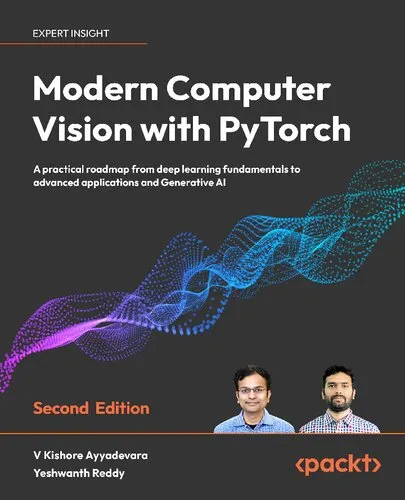
Modern Computer Vision with PyTorch: A Practical Roadmap From Deep Learning Fundamentals to Advanced Applications and Generative AI, 2nd Edition
V Kishore Ayyadevara,Yeshwanth Reddy
2023
View book