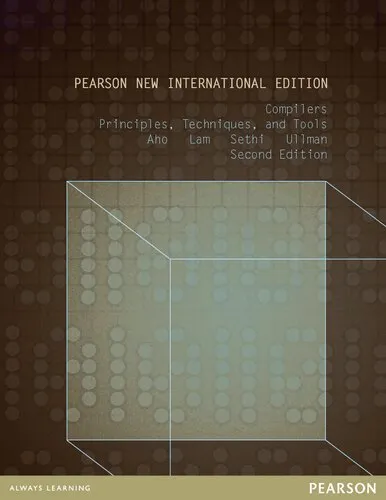
Compilers: Pearson New International Edition: Principles, Techniques, and Tools
A.V. Aho,Monica S Lam,R. Sethi,Jeffrey D. Ullman
2013
View book
Book guide and evaluation
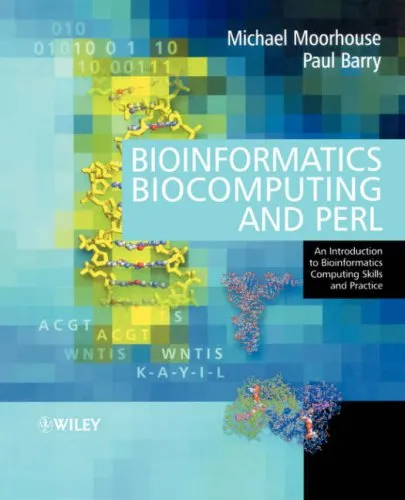
Michael Moorhouse,Paul Barry
0 reviews
Published
pages
views
Introduction to "Bioinformatics Biocomputing and Perl" Welcome to the fascinating world of bioinformatics and biocomputing! "Bioinformatics Biocomputing and Perl: An Introduction to Bioinformatics Computing Skills and Practice" is an essential resource for students
Before you read
Welcome to the fascinating world of bioinformatics and biocomputing! "Bioinformatics Biocomputing and Perl: An Introduction to Bioinformatics Computing Skills and Practice" is an essential resource for students, researchers, and professionals seeking to enhance their knowledge of computational methods used in modern biology. Authored with precision and clarity, this book combines the power of bioinformatics principles with practical applications using the Perl programming language, creating a bridge between biological sciences and computational mastery.
Bioinformatics is revolutionizing biological research, offering powerful tools to understand the complexities of genomics, proteomics, and evolutionary biology. This book provides a comprehensive approach to tackling bioinformatics challenges, covering both theoretical principles and hands-on implementation. Perfect for beginners and intermediate users alike, it introduces the core foundations of bioinformatics while delving into the real-world application of Perl scripting to solve biological data problems.
The book is structured to guide the reader through the essentials of bioinformatics in a step-by-step manner. Starting with an overview of what bioinformatics entails, it explains the importance of computational power in managing and analyzing biological datasets. The early chapters introduce Perl, a versatile programming language widely embraced by the bioinformatics community for its text-handling power and efficiency.
Through meticulously designed chapters, the text explores key topics such as sequence analysis, pattern matching, and regular expressions, which form the foundation of bioinformatics programming. Readers also learn techniques for accessing and manipulating public genetic databases, analyzing DNA and protein sequences, and performing tasks such as alignment and motif searching.
The book integrates theoretical discussions with practical examples, ensuring that complex concepts are made approachable. Exercises and code examples are included throughout to reinforce the learning experience. Whether you are studying evolution through alignments or delving into data mining, each chapter builds on prior knowledge and culminates in actionable skills.
“Bioinformatics is more than just software—it’s a mindset of asking biological questions in computational ways.”
“The beauty of Perl lies not only in its simplicity but also in its adaptability to biological problems.”
“When biology and computation meet, the boundaries of science are redefined.”
In an era where biology generates massive amounts of data, the ability to analyze and interpret this data is paramount. "Bioinformatics Biocomputing and Perl" serves as a crucial guide in bridging the gap between biology and computational analysis. Its practical approach enables readers to solve real biological problems while developing programming acumen.
The integration of Perl programming into bioinformatics workflows makes this book uniquely positioned to benefit those involved in genomic research, evolutionary studies, and biotechnology. Unlike many dry technical manuals, this book emphasizes learning by doing, empowering readers to immediately apply their skills to authentic challenges. It promotes a mindset of curiosity and innovation, which is vital for tackling today’s complex biological questions.
For educators, students, and professionals in life sciences, this book is a valuable resource that demystifies the complexities of bioinformatics while instilling confidence in computational problem-solving. Its enduring relevance lies in equipping readers with not just tools, but also a lifelong approach to interdisciplinary learning.
Your question is answered in the context of this title and author. Each answer uses 2 points.
0 reviews, 4.0 average out of 5
Sign in to publish a review.
Ask a focused question and learn from the community.
Related references that continue this learning path.
A.V. Aho,Monica S Lam,R. Sethi,Jeffrey D. Ullman
Wladston Ferreira Filho