Book guide and evaluation
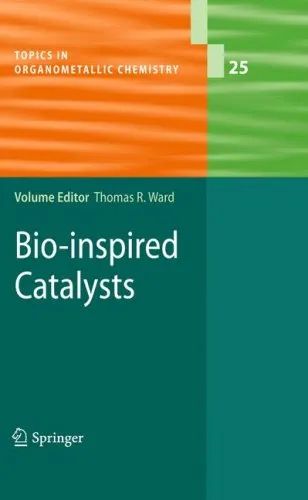
Bio-inspired catalysts
Ewold W Dijk,Ben L. Feringa,Gerard Roelfes (auth.),Thomas R. Ward (eds.)
English
Beginner
Product Management
4.6 / 5
0 reviews
2009
Published
121
pages
387
views
In order to meet the ever-increasing demands for enantiopure compounds, heteroge- ous, homogeneous and enzymatic catalysis evolved independently in the past. Although all three approaches have yielded industrially viable processes, the latter two are the most widely used and can
Before you read
What will you get from this book?
In order to meet the ever-increasing demands for enantiopure compounds, heteroge- ous, homogeneous and enzymatic catalysis evolved independently in the past. Although all three approaches have yielded industrially viable processes, the latter two are the most widely used and can be regarded as complementary in many respects. Despite the progress in structural, computational and mechanistic studies, however, to date there is no universal recipe for the optimization of catalytic processes. Thus, a trial-and-error approach remains predominant in catalyst discovery and optimization. With the aim of complementing the well-established fields of homogeneous and enzymatic catalysis, organocatalysis and artificial metalloenzymes have enjoyed a recent revival. Artificial metalloenzymes, which are the focus of this book, result from comb- ing an active but unselective organometallic moiety with a macromolecular host. Kaiser and Whitesides suggested the possibility of creating artificial metallo- zymes as long ago as the late 1970s. However, there was a widespread belief that proteins and organometallic catalysts were incompatible with each other. This severely hampered research in this area at the interface between homogeneous and enzymatic catalysis. Since 2000, however, there has been a growing interest in the field of artificial metalloenzymes for enantioselective catalysis. The current state of the art and the potential for future development are p- sented in five well-balanced chapters. G. Roelfes, B. Feringa et al. summarize research relying on DNA as a macromolecular host for enantioselective catalysis.
Ask this book
Your question is answered in the context of this title and author. Each answer uses 2 points.
Sign in to ask the book assistant.
Reader reviews
0 reviews, 4.6 average out of 5
No reviews yet
If you have read this book, help the next reader with your experience.
Write a review
Sign in to publish a review.
Reader questions and answers
Ask a focused question and learn from the community.
Sign in to ask or answer a question.
No questions yet
Be the first to ask a clear, useful question.
What to read next
Related references that continue this learning path.
Unlocking the customer value chain: how decoupling drives consumer disruption
Piechota, Greg;Teixeira, Thales S
2019
View book