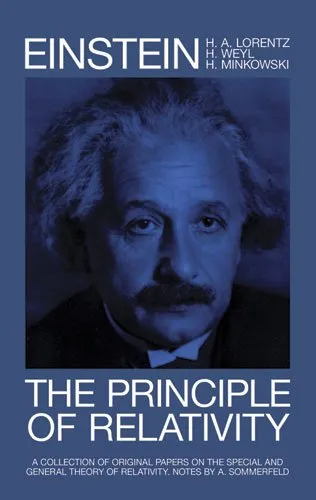
The Principle of Relativity (Dover Books on Physics)
Hendrik A. Lorentz,Albert Einstein,H. Minkowski,H. Weyl
1952
View book
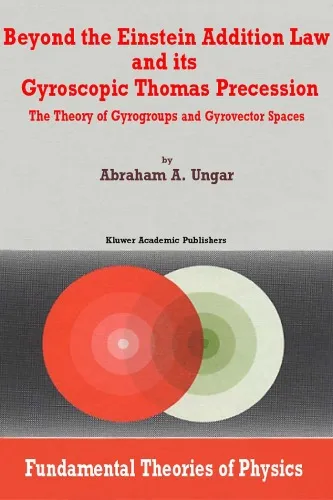
Book guide and evaluation
Abraham A. Ungar
0 reviews
Published
pages
views
Introduction In the riveting journey beyond the Einstein addition law, the book 'Beyond the Einstein Addition Law and its Gyroscopic Thomas Precession: The Theory of Gyrogroups and Gyrovector Spaces' delves into the fascinating realms of gyrogroups and gyrovector spaces, pione
Before you read
In the riveting journey beyond the Einstein addition law, the book 'Beyond the Einstein Addition Law and its Gyroscopic Thomas Precession: The Theory of Gyrogroups and Gyrovector Spaces' delves into the fascinating realms of gyrogroups and gyrovector spaces, pioneering concepts in modern theoretical physics. The work of Abraham A. Ungar provides a comprehensive framework that extends traditional vector addition in Minkowski spaces, offering significant insights into the intricacies of non-Euclidean geometry and relativistic physics.
This book challenges the very foundations of conventional knowledge on Einstein's velocity addition. The exploration navigates through the mathematical corridors of gyrogroups and gyrovector spaces, unfurling a revolutionary approach to understanding velocity and vector spaces in the context of special relativity. Gyrogroups account for Thomas precession, a phenomenon Einstein's velocity addition alone cannot completely explain.
The exposition begins with a historical overview of Einstein's velocity addition, demonstrating its limitations and the necessity for a more robust framework. Ungar introduces gyrogroups as algebraic structures that extend group theory, with gyrocommutative properties forming the backbone of this novel mathematical landscape. This extends to gyrovector spaces, acting as the natural generalization of vector spaces adapted to hyperbolic geometry—a crucial leap in comprehending relativistic quandaries.
The book meticulously blends theory with application, revealing how the new algebraic structures resolve anomalies in relativistic velocity addition and influence gyroscopic precision navigations. These innovations are embedded within a deeply mathematical narrative, accentuated by proofs, examples, and diagrams that illuminate the concepts for both seasoned physicists and ambitious students alike.
"The elegance of gyrogroups lies not just in their algebraic novelty but in their power to illuminate the shadows cast by Einstein’s postulates."
"In the dance of physics and mathematics, it is often the unseen steps—like those of gyrovector spaces—that prompt the most profound revolutions."
This book serves as a cornerstone for anyone delving into the frontiers of physics, grappling with the challenges left unsolved by classical theories. As technology scales greater heights, the precision demanded in theoretical frameworks increases correspondingly. Understanding gyrogroups and gyrovector spaces becomes critical in the age of advanced space navigation and cosmological exploration. Additionally, the book fosters a critical mindset, urging readers to question established doctrines and strive towards innovative resolutions.
Ungar's work is not just an academic triumph but a beckoning call to broaden the horizons of scientific inquiry, encouraging an evolution of ideas analogous to the very physics it elaborates upon.
Your question is answered in the context of this title and author. Each answer uses 2 points.
0 reviews, 4.0 average out of 5
Sign in to publish a review.
Ask a focused question and learn from the community.
Related references that continue this learning path.
Hendrik A. Lorentz,Albert Einstein,H. Minkowski,H. Weyl
Hanoch Gutfreund,Jürgen Renn,John Stachel
Einstein, Albert;Greene, Brian