

Book guide and evaluation
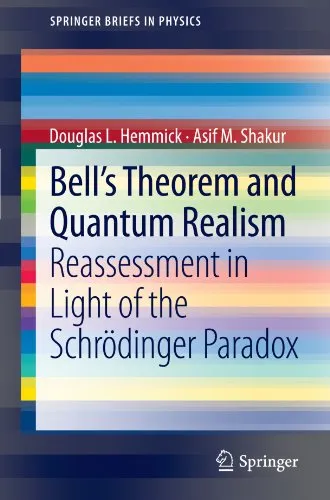
Bell's Theorem and Quantum Realism: Reassessment in Light of the Schrödinger Paradox
Douglas L. Hemmick,Asif M. Shakur (auth.)
English
Beginner
Physics
4.8 / 5
0 reviews
2012
Published
104
pages
267
views
Bell's Theorem and Quantum Realism: Reassessment in Light of the Schrödinger Paradox By Douglas L. Hemmick and Asif M. Shakur In the intricate tapestry of modern science, quantum mechanics has positioned itself as both a profound mystery and an unparalleled triumph of t
Before you read
What will you get from this book?
Bell's Theorem and Quantum Realism: Reassessment in Light of the Schrödinger Paradox
By Douglas L. Hemmick and Asif M. Shakur
In the intricate tapestry of modern science, quantum mechanics has positioned itself as both a profound mystery and an unparalleled triumph of theory and experiment. "Bell's Theorem and Quantum Realism: Reassessment in Light of the Schrödinger Paradox" revisits and reexamines some of the deepest questions about the nature of reality itself. This rigorous and enlightening book seeks to bridge the gap between abstract mathematical formulations and their philosophical implications, while addressing critical unresolved conceptual tensions in quantum theory.
Written for physicists, philosophers, and those exploring the depths of science, this book expertly delves into the intersection of two of the most puzzling aspects of quantum mechanics: Bell's theorem and Schrödinger's paradox. By carefully reassessing both in the light of modern theoretical discourse and experimental progress, the authors aim to provide clarity on quantum realism—a concept questioning whether the quantum formulation accurately reflects objective physical reality or simply constitutes a predictive tool.
Detailed Summary of the Book
The book is structured around the interplay of foundational questions that lie at the heart of quantum mechanics. John Bell's seminal theorem demonstrated that no theory combining local realism—a framework where physical properties exist independently of observation and cannot affect distant objects—can fully reproduce the predictions of quantum physics. This result, corroborated by decades of experiments, undermines classical intuitions about the nature of reality while boldly championing the strange, non-local essence of the quantum world.
Equally captivating is Schrödinger's paradox, commonly referred to as the "Schrödinger's cat" thought experiment. This paradox illuminates the perplexing interplay of superposition and measurement, exposing an apparent disconnect between the microscopic quantum world and the macroscopic classical realm. These two hallmark quandaries—Bell's theorem and the Schrödinger paradox—are intertwined to present a formidable challenge to our understanding of reality.
In this book, Hemmick and Shakur reconsider these ideas not merely as abstract philosophical dilemmas but as gateways to deeper truths about the natural world. The authors explore classical interpretations, realism, determinism, and the implications of Bell's theorem alongside experimental advancements. They guide readers through the broader implications of accepting or rejecting quantum non-locality, all while situating these discussions within broader debates about the nature of knowledge, objectivity, and causality.
The book concludes with an invitation to reassess quantum realism through new lenses, encouraging physicists and readers alike to explore alternative frameworks or reinterpret existing results. This is not just a passive retelling of accepted interpretations but an active inquiry into unexplored possibilities within the quantum-mechanical landscape.
Key Takeaways
- Bell's theorem challenges the notion of local realism, demonstrating that quantum mechanics fundamentally departs from classical intuitions about separability and locality.
- Schrödinger's cat paradox highlights the unresolved clashes between quantum superposition and macroscopic reality.
- The book critically evaluates both philosophical and experimental implications of non-locality and realism in the quantum framework.
- The boundaries of quantum mechanics provide fertile ground for discussions about determinism, causality, and alternative interpretations.
- Encourages the reader to rethink quantum realism in light of its foundational contradictions and experimental substantiations.
Famous Quotes from the Book
“The non-local nature of quantum entanglement forces us to reconsider the deepest assumptions about separability and independence in the physical world—concepts once viewed as fundamental.”
“While the cat serves as a metaphor for quantum peculiarity, it also acts as an invitation for humanity to confront the gap between theory and reality.”
Why This Book Matters
The importance of "Bell's Theorem and Quantum Realism" lies not only in its exploration of quantum paradoxes but also in its broader implications for science and philosophy. Bell's theorem and Schrödinger's paradox have remained at the forefront of debates about the nature of reality since their inception. This book makes valuable contributions by providing a clear, accessible explanation of these ideas while encouraging readers to think critically about their conceptual consequences.
Furthermore, this book serves as a reminder of the essential interplay between science and philosophy. It challenges scientists, philosophers, and students of physics to reconsider the meaning of wave functions, entanglement, and measurement, providing new perspectives on old questions. It is a must-read for anyone passionate about understanding the deeper truths of the universe and the historical and philosophical undercurrents shaping quantum theory today.
Ask this book
Your question is answered in the context of this title and author. Each answer uses 2 points.
Sign in to ask the book assistant.
Reader reviews
0 reviews, 4.8 average out of 5
No reviews yet
If you have read this book, help the next reader with your experience.
Write a review
Sign in to publish a review.
Reader questions and answers
Ask a focused question and learn from the community.
Sign in to ask or answer a question.
No questions yet
Be the first to ask a clear, useful question.
What to read next
Related references that continue this learning path.


Modern Computer Vision with PyTorch: A Practical Roadmap From Deep Learning Fundamentals to Advanced Applications and Generative AI, 2nd Edition
V Kishore Ayyadevara,Yeshwanth Reddy
2023
View book