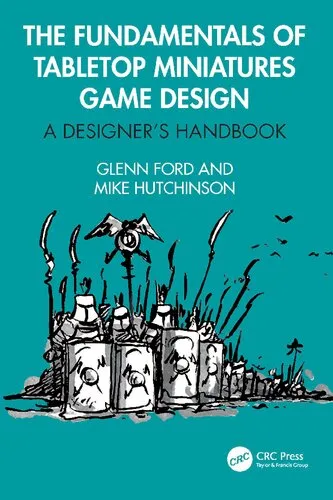
The Fundamentals of Tabletop Miniatures Game Design: A Designer’s Handbook
Glenn Ford,Mike Hutchinson
2024
View book
Book guide and evaluation
Dave (Dave Mark) Mark
0 reviews
Published
pages
views
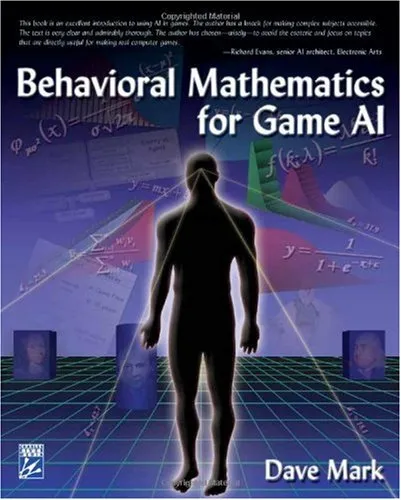
Introduction to "Behavioral Mathematics for Game AI" "Behavioral Mathematics for Game AI" is a groundbreaking exploration of the symbiotic relationship between mathematics, human psychology, and artificial intelligence in the domain of video games. Written by Dave Mark, th
Before you read
"Behavioral Mathematics for Game AI" is a groundbreaking exploration of the symbiotic relationship between mathematics, human psychology, and artificial intelligence in the domain of video games. Written by Dave Mark, this book delves into the most intricate and fascinating aspects of game design: creating engaging and believable behavior in non-player characters (NPCs) through mathematical models and behavioral principles. Aimed at both novices and experienced game developers, the book outlines foundational theories, practical examples, and advanced strategies for crafting smarter and more compelling AI—ensuring that games feel immersive, challenging, and rewarding.
At its core, the book transcends the purely technical lens of AI development by bridging the gap between abstract mathematical constructs and human-like decision-making. It transforms a traditional technical topic into something relatable and applicable, enabling game designers to resonate with players' expectations and emotions. Whether you're working on increasing player engagement, fine-tuning NPC reactions, or building complex systems for emergent gameplay, this book is a rich repository of actionable insights and real-world examples.
The journey begins with an exploration of human psychology and decision-making. The book introduces readers to concepts like bounded rationality, probability, and risk assessment, which are then connected to the creation of artificial agents. Utilizing these principles, "Behavioral Mathematics for Game AI" demonstrates how mathematics can be leveraged to simulate believable, human-like behaviors in NPCs and systems.
Throughout the book, Dave Mark breaks down complex topics into digestible chapters, covering areas such as:
By anchoring AI development in natural human tendencies and decision-making models, the book offers a paradigm shift in how we think about AI design. As a result, developers are equipped not only to build technically complex systems but also to elevate gameplay by making NPCs genuinely exciting and relatable.
"Behavioral Mathematics for Game AI" ensures that readers walk away with a rounded understanding of AI development for games, encompassing theory, design principles, technical applications, and player-centric thinking. Some key takeaways include:
These takeaways empower game developers to close the gap between computation and creativity, ensuring NPCs contribute meaningfully to the player experience.
The book is rich with thought-provoking insights and memorable lines, some of which serve as guiding principles for developers:
"The goal isn't to create intelligence; it's to create the illusion of intelligence."
"AI should respond not simply as a machine, but as a character with a personality, a past, and a purpose."
"Believability in AI is achieved not through perfection, but through relatability."
In an age where gaming technology constantly pushes boundaries, "Behavioral Mathematics for Game AI" stands out as a transformative work for a fundamental reason: it bridges a gap in game design and development that is often overlooked. While technical innovation has brought us breathtaking graphics and expansive worlds, it is the characters within these worlds that breathe life into them. By teaching developers how to infuse mathematical logic with behavioral psychology, Dave Mark's book empowers creators to move beyond generic NPC behaviors and create game worlds where NPCs feel earnest and believable.
Another reason this book is indispensable is its focus on the player. While it caters to developers, its lessons hinge on understanding and predicting player behavior. It ensures that NPCs and systems work in concert to deliver unforgettable gaming experiences. As gaming continues to evolve, incorporating ideas around player psychology and human-guided AI is not just advantageous—it’s essential.
Whether you’re an indie game developer building your first mechanics, a veteran designer looking to sharpen your AI approach, or simply a student of game theory and psychology, this book offers an unparalleled foundation. It’s a must-read for anyone striving to create games that don’t just entertain but also engage, challenge, and inspire players in profound ways.
Your question is answered in the context of this title and author. Each answer uses 2 points.
0 reviews, 4.9 average out of 5
Sign in to publish a review.
Ask a focused question and learn from the community.
Related references that continue this learning path.
Glenn Ford,Mike Hutchinson