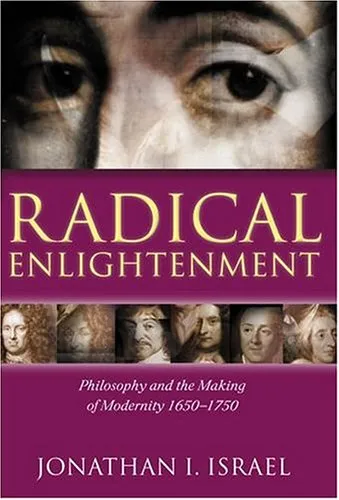
Radical Enlightenment. Philosophy and the Making of Modernity 1650-1750
Jonathan I. Israel
2001
View book
Book guide and evaluation
Michael Heyd
0 reviews
Published
pages
views
Introduction to "Be Sober and Reasonable" Welcome to an in-depth exploration of "Be Sober and Reasonable": The Critique of Enthusiasm in the Seventeenth and Early Eighteenth Centuries, a critical work that delves into the complex intellectual landscape of the late Renaissance
Before you read
Welcome to an in-depth exploration of "Be Sober and Reasonable": The Critique of Enthusiasm in the Seventeenth and Early Eighteenth Centuries, a critical work that delves into the complex intellectual landscape of the late Renaissance and the Enlightenment. This book, written by Michael Heyd, offers an insightful examination of the fear and skepticism surrounding religious enthusiasm during a transformative period in European history.
In "Be Sober and Reasonable," Michael Heyd examines the heated debates around religious enthusiasm that took hold during the 17th and early 18th centuries. This era was marked by religious upheaval, leading many to become wary of intense expressions of faith perceived as irrational or fanatical. The book provides a thorough analysis of how philosophers, theologians, and other intellectuals responded to and sought to control the influence of enthusiasm. Heyd considers the reactions of key figures such as John Locke, who sought a balance between reason and emotion, needing both for a healthy religious life. By scrutinizing the works and thoughts of these seminal thinkers, the book captures the tension between emerging rationality and traditional religious fervor.
Crucially, Heyd illustrates that the critique of enthusiasm wasn't simply an attack on religion but a broader concern about social order and authority. He delves into the writings of figures who argued for moderation and used the rhetoric of sobriety and reason to assert control over what was seen as chaotic, uncontrolled enthusiasm. The book is structured to methodically unveil the philosophical, theological, and cultural layers that contributed to this significant intellectual discourse.
"To label someone an enthusiast was as much a political and social judgment as it was a religious one."
"The struggle to define and control enthusiasm reflected larger battles over authority and individual freedom."
This book is essential for understanding not just the past but the ways in which historical perspectives on religious fervor continue to shape modern discourses on reason, belief, and social order. It lays bare the intellectual currents that flowed beneath the surface of overt religious controversies and highlights how these debates paralleled and influenced broader societal changes. For historians, philosophers, and theologians, Heyd's work offers a nuanced narrative that enriches our grasp of the intellectual revolution that was the Enlightenment. Furthermore, it provides a crucial context for grappling with today's ideological divides, rooted in historical approaches to belief and emotion.
Your question is answered in the context of this title and author. Each answer uses 2 points.
0 reviews, 4.0 average out of 5
Sign in to publish a review.
Ask a focused question and learn from the community.
Related references that continue this learning path.
Jonathan I. Israel