Conceptual Modeling: Foundations and Applications: Essays in Honor of John Mylopoulos
Michael L. Brodie (auth.),Alexander T. Borgida,Vinay K. Chaudhri,Paolo Giorgini,Eric S. Yu (eds.)
2009
View book
Book guide and evaluation
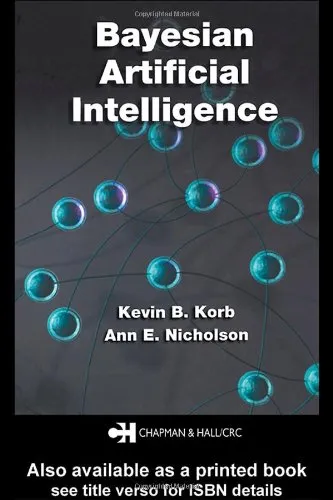
Kevin B. Korb Ann E. Nicholson
0 reviews
Published
pages
views
Introduction to Bayesian Artificial Intelligence The realm of Artificial Intelligence (AI) is vast and continually evolving, with Bayesian Artificial Intelligence standing out as a pivotal approach that employs probability theory to enhance decision-making processes and
Before you read
The realm of Artificial Intelligence (AI) is vast and continually evolving, with Bayesian Artificial Intelligence standing out as a pivotal approach that employs probability theory to enhance decision-making processes and model uncertainty. Our book, Bayesian Artificial Intelligence, delves deep into the foundational principles, methodologies, and applications of Bayesian methods in AI, offering readers an insightful journey through this essential facet of intelligent systems.
In this comprehensive text, we explore the integration of Bayesian networks and probabilistic models into AI systems. The book is meticulously structured to guide both novice and experienced readers through the Bayesian landscape. Initially, we lay down the theoretical underpinnings of Bayesian probability which serve as the backbone of Bayesian networks. Subsequent chapters progress into the construction and application of these networks, emphasizing their utility in managing uncertainty and learning from data.
One key section of the book is dedicated to machine learning techniques enhanced by Bayesian methods. We elaborate on both supervised and unsupervised learning paradigms, showcasing how Bayesian reasoning can vastly improve the predictive accuracy and robustness of AI models. A variety of algorithms, including Markov Chain Monte Carlo and Bayesian belief networks, are dissected to reveal their potential in real-world applications.
The latter part of the book delves into specific applications of Bayesian AI, such as natural language processing, robotics, and decision support systems. Through these real-world examples, we illustrate the practical impact of Bayesian methods and demonstrate their adaptability across different domains. The book concludes with a forward-looking perspective on emerging trends and future developments in Bayesian AI.
"In the realm of uncertainty, Bayesian methods provide the beacon of clarity."
"Understanding probability is not just about numbers; it’s about making informed decisions."
Bayesian Artificial Intelligence is not just another academic text. It addresses a crucial aspect of modern AI that many other works overlook—managing uncertainty with precision and foresight. As AI systems increasingly take on roles that require nuanced decision-making, the importance of understanding and employing Bayesian methods becomes paramount. This book equips researchers, practitioners, and enthusiasts with the necessary tools and perspectives to harness the full potential of Bayesian AI.
The methodologies discussed in this book are at the forefront of creating AI systems that are not only intelligent but also reliable and interpretable. As the field of AI advances, mastering Bayesian techniques will be indispensable for anyone looking to make significant contributions to the discipline. Thus, our book serves as an essential resource for shaping the future leaders of AI innovation.
Your question is answered in the context of this title and author. Each answer uses 2 points.
0 reviews, 4.5 average out of 5
Sign in to publish a review.
Ask a focused question and learn from the community.
Related references that continue this learning path.
Michael L. Brodie (auth.),Alexander T. Borgida,Vinay K. Chaudhri,Paolo Giorgini,Eric S. Yu (eds.)
James R. Thompson