
Book guide and evaluation
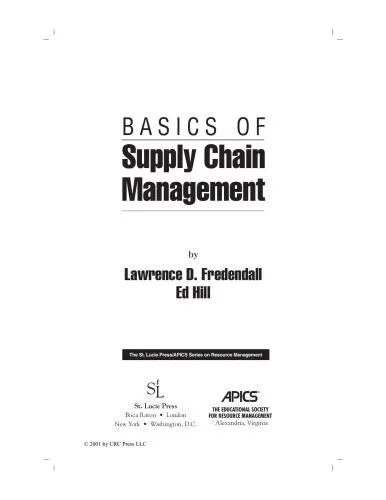
Basics of Supply Chain Management (Resource Management)
Lawrence D. Fredendall,Ed Hill
English
Beginner
Economics
4.8 / 5
0 reviews
2000
Published
235
pages
232
views
Introduction to "Basics of Supply Chain Management (Resource Management)" The supply chain is the backbone of modern business operations, driving efficiency, customer satisfaction, and profitability across industries. In "Basics of Supply Chain Management (Resour
Before you read
What will you get from this book?
Introduction to "Basics of Supply Chain Management (Resource Management)"
The supply chain is the backbone of modern business operations, driving efficiency, customer satisfaction, and profitability across industries. In "Basics of Supply Chain Management (Resource Management)," we delve into the fundamental principles, best practices, and critical concepts that define a world-class supply chain. This comprehensive guide caters to both seasoned professionals and newcomers alike, offering a holistic overview of resource management and operational strategies that shape organizations' success. Authored with clarity and precision, this book provides insights into managing workflows, enhancing coordination, and streamlining supply chain processes in today's dynamic market environments.
Building on years of expertise and real-world applications, this book focuses on issues such as inventory planning, demand forecasting, production scheduling, and logistics resource allocation. Each chapter equips readers with the knowledge to tackle challenges head-on, whether they are rethinking an organization's supply chain strategy or trying to optimize real-time logistics.
Detailed Summary of the Book
At the heart of this book lies a structured analysis of supply chain dynamics and essential resource management principles. By combining theoretical frameworks with practical applications, the text serves as a foundation for supply chain excellence. Each chapter is designed to build upon the last, covering a wide range of topics such as:
- Understanding the fundamentals of supply chain management and its role in modern business.
- Detailed insights into production and operations management as an interconnected system.
- Exploration of inventory management techniques, including Just-in-Time (JIT) and Economic Order Quantity (EOQ).
- Methods for enhancing supplier relationships and optimizing procurement processes.
- Demand forecasting and capacity planning to ensure seamless operations.
- Integration of technology and software solutions for data-driven decision-making.
- Sustainability and ethics in supply chain practices.
Each concept is broken down into digestible sections, followed by real-world case studies and examples that illustrate its application in diverse industries. By the end of the book, readers are well-prepared to approach complex supply chain problems with confidence and a data-driven mindset.
Key Takeaways
This book not only provides an academic perspective on supply chain management but also equips readers with actionable insights and tools. Here are some key takeaways:
- Clear understanding of how supply chains function and the importance of cross-functional integration.
- Mastery of resource planning methodologies to eliminate waste and maximize efficiency.
- Techniques for managing risks and uncertainties within the supply chain.
- Strategies for improving customer satisfaction through timely and accurate distribution systems.
- The relationship between supply chain optimization and overall business performance growth.
Armed with these insights, readers will be better equipped to lead supply chain initiatives in their organizations, making informed decisions that drive tangible results.
Famous Quotes from the Book
"Basics of Supply Chain Management (Resource Management)" is filled with thought-provoking insights and practical wisdom. Here are some memorable quotes:
"A seamless supply chain is not just an operational achievement—it is a competitive advantage that defines a company’s success."
"Inventory is money sitting on the shelf. Managing it properly is the foundation of resource optimization."
"The goal of supply chain management is not simply to move goods efficiently but to integrate every component of the process so that value and service are maximized."
Why This Book Matters
In an era defined by global competition and rapidly advancing digital technologies, supply chain management has never been more critical to organizational success. This book fills a vital gap by providing straightforward, actionable strategies for improving supply chain operations. Whether you are a student, business leader, or supply chain professional, the concepts and strategies discussed in this book will help you:
- Navigate the complexities of modern supply chains in a globalized economy.
- Develop a deep understanding of resource allocation and process optimization.
- Stay competitive by integrating sustainability and innovation into supply chain practices.
- Prepare for certification programs like the APICS CPIM (Certified in Production and Inventory Management).
Supply chain management shapes the success of industries ranging from manufacturing to retail to healthcare. By mastering its fundamentals, professionals can position themselves as vital contributors to their organization's growth. This book stands as an indispensable guide to achieving such mastery.
Ask this book
Your question is answered in the context of this title and author. Each answer uses 2 points.
Sign in to ask the book assistant.
Reader reviews
0 reviews, 4.8 average out of 5
No reviews yet
If you have read this book, help the next reader with your experience.
Write a review
Sign in to publish a review.
Reader questions and answers
Ask a focused question and learn from the community.
Sign in to ask or answer a question.
No questions yet
Be the first to ask a clear, useful question.
What to read next
Related references that continue this learning path.
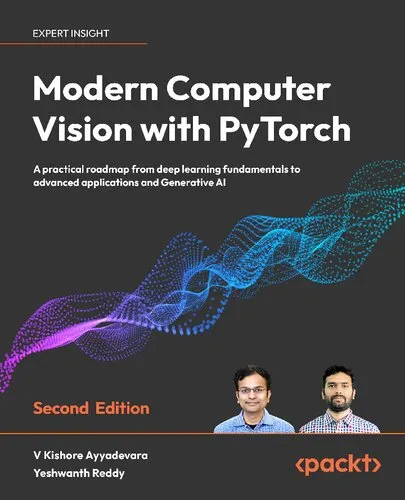
Modern Computer Vision with PyTorch: A Practical Roadmap From Deep Learning Fundamentals to Advanced Applications and Generative AI, 2nd Edition
V Kishore Ayyadevara,Yeshwanth Reddy
2023
View book