

Book guide and evaluation
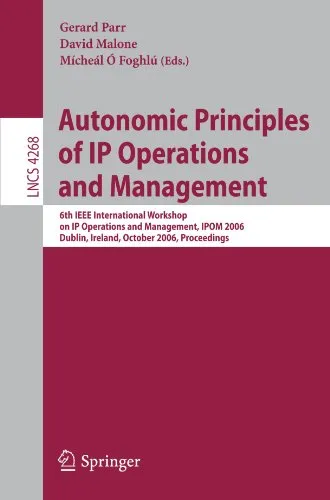
Autonomic Principles of IP Operations and Management: 6th IEEE International Workshop on IP Operations and Management, IPOM 2006, Dublin, Ireland, October 23-25, 2006. Proceedings
Dinil Mon Divakaran,Hema A. Murthy,Timothy A. Gonsalves (auth.),Gerard Parr,David Malone,Mícheál Ó Foghlú (eds.)
English
Beginner
Software Engineering
4.4 / 5
0 reviews
2006
Published
247
pages
156
views
Introduction The book "Autonomic Principles of IP Operations and Management" presents a comprehensive exploration of the autonomic principles applied to the domain of Internet Protocol (IP) networks. As the proceedings from the 6th IEEE International Workshop on IP Operati
Before you read
What will you get from this book?
Introduction
The book "Autonomic Principles of IP Operations and Management" presents a comprehensive exploration of the autonomic principles applied to the domain of Internet Protocol (IP) networks. As the proceedings from the 6th IEEE International Workshop on IP Operations and Management (IPOM 2006), this volume captures the cutting-edge research, discussions, and insights shared at the event held in Dublin, Ireland, from October 23-25, 2006. It is a valuable resource for academics, researchers, network operators, and technology enthusiasts keen on understanding the evolving landscape of autonomic networking and its application in IP operations.
Seamlessly blending theory with real-world scenarios, the book highlights the challenges of managing modern IP-based infrastructures and the revolutionary opportunities offered by autonomic principles. At its core, the text emphasizes how self-configuration, self-healing, self-optimization, and self-protection—key tenets of autonomic computing—are reshaping the management of complex networks.
Detailed Summary
The development of IP-based communication systems has drastically transformed the way we communicate and engage with technology. However, with the increasing complexity and scale of networks, traditional management methods have proven insufficient. This book delves into how autonomic principles can address these challenges, providing a systematic and disciplined way to enhance IP operations and management.
Divided into several contributions from leading researchers, the book discusses a range of topics such as:
- The design and architecture of autonomic network systems.
- Real-world applications and case studies of autonomic management in IP networks.
- Performance and fault management using self-governing mechanisms.
- The integration of policy-based management for enhanced decision-making processes.
- Innovative frameworks for security, scalability, and adaptability in autonomic networks.
Key Takeaways
Readers of this book will gain the following critical insights:
- A deep understanding of autonomic concepts and their practical implications for IP operations.
- An appreciation for the challenges associated with operating complex networks and how autonomic management can streamline these processes.
- The ability to implement self-management principles like self-configuration and self-optimization in network deployments.
- Exposure to solutions for improving network reliability, scalability, and security using autonomic approaches.
- Inspiration to contribute to the ever-evolving field of autonomic computing and networking.
Famous Quotes from the Book
This book contains several thought-provoking quotes and ideas that encapsulate its essence. Here are a few notable excerpts:
"The future of networking lies not in manual control but in systems that adapt, learn, and evolve autonomously."
"Autonomic systems empower networks with resilience comparable to biological organisms, enabling seamless adaptation to changing environments."
Why This Book Matters
The significance of "Autonomic Principles of IP Operations and Management" cannot be overstated. With the rapid expansion of networks and surging internet usage, the pressure on network managers to ensure reliability, efficiency, and security has grown exponentially. This book provides a roadmap to leverage the power of autonomic computing, transforming the paradigm of IP operations and management.
By offering a blend of theoretical insights and practical applications, it serves as a critical reference point for academic researchers and industry practitioners alike. Whether addressing the scalability challenges of large-scale networks or enhancing the adaptability of dynamic systems, the principles discussed in this book lay the groundwork for the next generation of intelligent networks. For anyone interested in the intersection of technology, networking, and automation, this book serves as both an inspiration and a practical guide.
Ultimately, this book underscores the importance of innovating within the realms of networking, emphasizing that autonomic principles are not just a concept of the future—they are rapidly becoming a necessity for the present.
Ask this book
Your question is answered in the context of this title and author. Each answer uses 2 points.
Sign in to ask the book assistant.
Reader reviews
0 reviews, 4.4 average out of 5
No reviews yet
If you have read this book, help the next reader with your experience.
Write a review
Sign in to publish a review.
Reader questions and answers
Ask a focused question and learn from the community.
Sign in to ask or answer a question.
No questions yet
Be the first to ask a clear, useful question.
What to read next
Related references that continue this learning path.



Modern Computer Vision with PyTorch: A Practical Roadmap From Deep Learning Fundamentals to Advanced Applications and Generative AI, 2nd Edition
V Kishore Ayyadevara,Yeshwanth Reddy
2023
View book