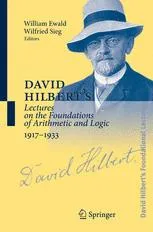
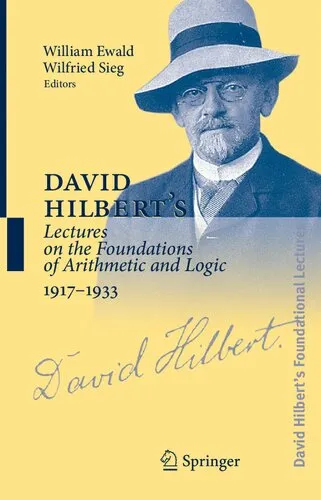
David Hilbert's Lectures on the Foundations of Arithmetic and Logic 1917-1933
William Ewald,Wilfried Sieg (auth.),William Ewald,Wilfried Sieg (eds.)
2013
View book
Book guide and evaluation
Gelbart Harder Iwasawa,Jacquet Katz Piatetski-Shapiro,Raghavan Shintani Stark Zagier (auth.)
0 reviews
Published
pages
views
Introduction to "Automorphic Forms, Representation Theory and Arithmetic: Papers presented at the Bombay Colloquium 1979" The study of automorphic forms, representation theory, and arithmetic has long been a cornerstone of modern mathematical research, uniting profound themes
Before you read
The study of automorphic forms, representation theory, and arithmetic has long been a cornerstone of modern mathematical research, uniting profound themes in number theory, algebra, and geometry. The book "Automorphic Forms, Representation Theory and Arithmetic: Papers presented at the Bombay Colloquium 1979" is a rich compilation of academic contributions by some of the most notable mathematicians of the era. It encapsulates groundbreaking insights and serves as an invaluable resource for students and researchers alike, distinguishing itself as a seminal work in the field.
Held in 1979, the Bombay Colloquium brought together leading scholars to discuss and develop some of the most advanced concepts in mathematics. The book is a collection of their contributions, offering a blend of theoretical advancements, practical applications, and mathematical frameworks that have influenced generations of research. This rare volume has become a vital reference point not only for its specialized content but also for its methodical and exploratory approach to deep mathematical problems.
The book consists of a curated selection of papers that reflect the intense intellectual activity and collaboration of the participants at the colloquium. It covers substantial aspects of automorphic forms, representation theory of algebraic groups, and arithmetic geometry. The themes explored in these papers include Eisenstein series, modular forms, L-functions, and representations of classical and p-adic groups.
The authors address critical questions about the relationships between automorphic forms and arithmetic, incorporating a variety of tools originating from algebraic geometry and representation theory. This interplay provides deeper insights into important conjectures, including those involving the Langlands program. Additionally, the book introduces new techniques and methodologies, offering readers not only a glimpse into the state of mathematics at the time but also a foundation for further exploration of these timeless problems.
Beyond purely theoretical discussions, many of the papers reveal connections to mathematical physics, algebraic topology, and combinatorics. This multidisciplinary approach renders the book a treasure trove for scholars interested in bridging different domains within mathematics.
"The study of automorphic forms is a gateway to understanding the broader relationships in mathematics, uniting the finite with the infinite, the algebraic with the analytic."
"Representation theory provides the language through which the arithmetic symmetries of automorphic forms can be expressed, enabling profound discoveries."
"The Langlands program is not merely a series of conjectures but a framework for perceiving mathematics itself as a unified entity."
This book stands as a testament to the advancements achieved during a critical juncture in mathematical history. The topics it covers are not limited to their theoretical significance; they are deeply connected to modern trends and applications, ranging from cryptography to quantum mechanics. By emphasizing the trio of automorphic forms, representation theory, and arithmetic, this volume underscores the importance of cross-disciplinary research.
Moreover, this book remains relevant today due to its rigorous but accessible treatment of challenging ideas. It represents an era when mathematical collaboration and exploration were at their peak, capturing the essence of a changing landscape in mathematical thought. Scholars and students revisiting this book not only gain valuable insights but also appreciate the depth and beauty of mathematics as a universal language.
In essence, "Automorphic Forms, Representation Theory and Arithmetic: Papers presented at the Bombay Colloquium 1979" is far more than a collection of technical papers. It is an enduring work that continues to inspire, challenge, and influence the mathematical community worldwide.
Your question is answered in the context of this title and author. Each answer uses 2 points.
0 reviews, 4.6 average out of 5
Sign in to publish a review.
Ask a focused question and learn from the community.
Related references that continue this learning path.
William Ewald,Wilfried Sieg (auth.),William Ewald,Wilfried Sieg (eds.)
William Ewald (editor),Wilfried Sieg (editor)