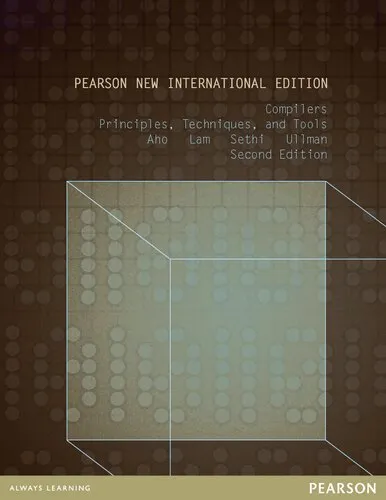
Compilers: Pearson New International Edition: Principles, Techniques, and Tools
A.V. Aho,Monica S Lam,R. Sethi,Jeffrey D. Ullman
2013
View book
Book guide and evaluation
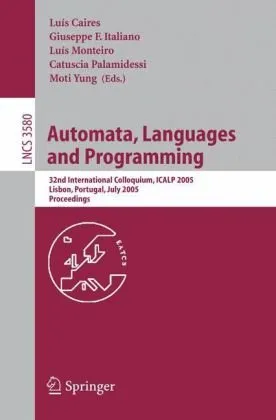
Leslie G. Valiant (auth.),Luís Caires,Giuseppe F. Italiano,Luís Monteiro,Catuscia Palamidessi,Moti Yung (eds.)
0 reviews
Published
pages
views
Introduction to "Automata, Languages and Programming: 32nd International Colloquium, ICALP 2005" The book "Automata, Languages and Programming: 32nd International Colloquium, ICALP 2005, Lisbon, Portugal, July 11-15, 2005. Proceedings" represents a significant contribution
Before you read
The book "Automata, Languages and Programming: 32nd International Colloquium, ICALP 2005, Lisbon, Portugal, July 11-15, 2005. Proceedings" represents a significant contribution to the field of theoretical computer science. This volume encapsulates the intellectual outcomes of ICALP 2005, a prestigious international conference where researchers and organizations gathered to discuss the latest innovations in automata theory, formal languages, computational models, algorithm design, and related theoretical advancements. It serves as an important resource for both foundational research and practical applications in the domain.
This proceedings volume is divided into three main tracks, focusing on key thematic areas of the conference: Track A: Algorithms, Automata, Complexity, and Games; Track B: Logic, Semantics, and Theory of Programming; and Track C: Security and Cryptography Foundations. Each track reflects cutting-edge research contributions and novel methodologies designed to solve complex computational problems. Drawing from over one hundred papers, this book provides a comprehensive view of the rapid growth and interdisciplinary nature of theoretical computer science.
The 32nd edition of the ICALP proceedings emphasizes the synergy between theory and practice, offering readers insights into groundbreaking results and transformative ideas within computer science. Track A introduces advancements in algorithms and data structures, as well as automata theory and complexity results that extend our understanding of computational limits. It delves into topics such as graph algorithms, probabilistic methods, and combinatorial optimization.
Track B focuses on the semantics of programming languages, logics for reasoning about software correctness, and theoretical foundations of software design. Papers in this track address critical topics such as type systems, concurrency models, and formal verification methods, helping bridge the gap between theoretical explorations and real-world software challenges.
Track C, a relatively recent addition to ICALP, explores the increasingly important domain of security and cryptography foundations. This track includes work on protocols for secure communication, cryptographic primitives, and the mathematical theories underpinning these domains. With cybersecurity threats becoming more ubiquitous, the research discussed in this track highlights the importance of theoretical precision for practical safety.
Collectively, the book underscores the interdisciplinary implications of automata, languages, and programming, reflecting how these areas influence other domains such as artificial intelligence, bioinformatics, and distributed systems. Its balance of theoretical exploration and practical application renders the volume invaluable to a diverse academic and professional audience.
"The pursuit of theoretical elegance in algorithms and automata has led to practical breakthroughs in computation, proving once more that innovation knows no boundaries."
"Logic and semantics provide the framework for reasoning about programs, enabling us to construct correct and reliable systems that anchor modern technology."
"Security and cryptography are the cornerstones of our digital world, and their theoretical foundations drive progress in ensuring our systems remain resilient and trustworthy."
This proceedings book is more than just a collection of academic works; it is a milestone that highlights the pivotal moments in the evolution of theoretical computer science. The ICALP 2005 proceedings bridge the gap between abstract computation models and their real-world applications, ensuring that theoretical advancements are not confined to academia but influence global industries.
For students, academics, and professionals alike, this volume provides the intellectual foundation necessary for addressing modern computational challenges. It inspires researchers to push the boundaries of science while equipping practitioners with the tools to solve complex problems. Moreover, the interdisciplinary nature of the book ensures its relevance in diverse domains, from artificial intelligence to secure communications.
By engaging with the topics discussed in this book, readers gain insight into the past, present, and future of computing. As we continue to move towards an increasingly digitized and interconnected world, the foundational research presented in this volume remains as relevant as ever.
Your question is answered in the context of this title and author. Each answer uses 2 points.
0 reviews, 4.5 average out of 5
Sign in to publish a review.
Ask a focused question and learn from the community.
Related references that continue this learning path.
A.V. Aho,Monica S Lam,R. Sethi,Jeffrey D. Ullman
Wladston Ferreira Filho