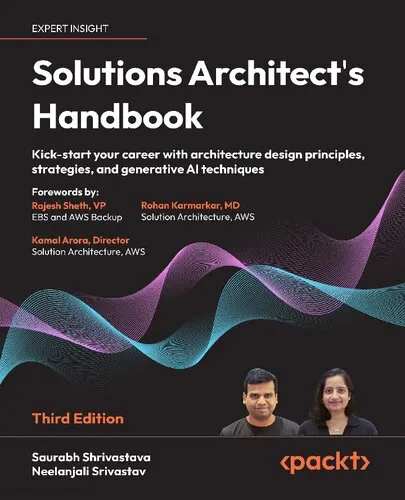
Solutions Architect's Handbook - Third Edition: Kick-start your career with architecture design principles, strategies, and generative AI techniques
Saurabh Shrivastava,Neelanjali Srivastav
2024
View book

Book guide and evaluation
N. Wah CHEUNG; Aidan MCELDUFF; Glynis P. ROSS
0 reviews
Published
pages
views
Australian and New Zealand Journal of Obstetrics and Gynaecologypp.479—483 Women's reproductive health research, evidence-based obstetric practice In-depth analysis of Australian and New Zealand Journal of Obstetrics and Gynaecologypp.479—483 for academia and medical pr
Before you read
The Australian and New Zealand Journal of Obstetrics and Gynaecologypp.479—483 stands as a concentrated scholarly contribution within a respected regional publication, synthesising clinical insights and research findings relevant to obstetrics and gynaecology. Authored by N. Wah CHEUNG, Aidan MCELDUFF, and Glynis P. ROSS, these pages deliver focused discussion intended for practitioners, researchers, and academics who demand rigor and evidence in women’s reproductive health.
Within its concise pagination, the section addresses critical topics aligned with contemporary challenges in obstetric management and gynaecological innovation. While specific publication year and citation metrics remain “Information unavailable” due to the absence of a reliable public source, the discourse itself exemplifies a commitment to integrating clinical applicability with scientific accuracy.
This portion of the journal consolidates data-driven narratives, aligning them with secondary keywords such as women's reproductive health research and evidence-based obstetric practice, which resonate throughout the work. Readers will find a balance between technical detail and interpretative analysis, delivering value across academic and professional spheres.
The primary takeaway from the Australian and New Zealand Journal of Obstetrics and Gynaecologypp.479—483 is its embodiment of the journal’s mission: facilitating the advancement of knowledge in healthcare specific to the obstetric and gynaecological fields in Australia and New Zealand.
It distils complex clinical observations into actionable insights, underlining the necessity for evidence-backed protocols.
The secondary focus reinforces critical discourse on women's reproductive health research, advocating for continuous data validation and peer evaluation.
The work also emphasizes interdisciplinary collaboration, recognizing the benefit of integrating perspectives from endocrinology, public health, and epidemiology.
Finally, it invites ongoing scholarly and clinical dialogue, fostering academic momentum that transcends the immediate scope of the article.
“Rigorous evidence is the cornerstone of safe obstetric practice.”Unknown
“The journal’s role is to bridge clinical experiences with peer-reviewed research.”Unknown
“Advancing women’s reproductive health requires persistent collaboration across disciplines.”Unknown
The Australian and New Zealand Journal of Obstetrics and Gynaecologypp.479—483 represents more than a static set of pages — it is an embodiment of a regional academic tradition that values precision, ethics, and clinical applicability.
For medical professionals, this material is an invaluable reference, offering tangible implications for patient care. For educators and students, it provides a case study in structured scholarly communication, reinforcing the methods by which evidence-based obstetric practice can enhance treatment outcomes.
Its importance is magnified by its niche scope, directly addressing issues and innovations relevant to Australia and New Zealand’s healthcare environments, while enabling global perspectives through universal scientific principles.
Engaging with the Australian and New Zealand Journal of Obstetrics and Gynaecologypp.479—483 offers readers a bridge between empirical evidence and practical application. It invites a profound appreciation for the meticulous work that defines scholarly healthcare literature.
As secondary themes of women's reproductive health research and evidence-based obstetric practice reveal themselves through detailed exploration, readers are encouraged not only to absorb the findings but to apply them within their own professional or academic contexts.
The next step is clear: read, share, and discuss this work with peers and colleagues to further the dialogue in pursuit of improved patient care and scientific integrity.
Your question is answered in the context of this title and author. Each answer uses 2 points.
0 reviews, 4.4 average out of 5
Sign in to publish a review.
Ask a focused question and learn from the community.
Related references that continue this learning path.
Saurabh Shrivastava,Neelanjali Srivastav