
Six Easy Pieces: Essentials of Physics Explained by Its Most Brilliant Teacher
Richard P. Feynman,Robert B. Leighton,Matthew Sands
2011
View book
Book guide and evaluation
Niels Bohr
0 reviews
Published
pages
views
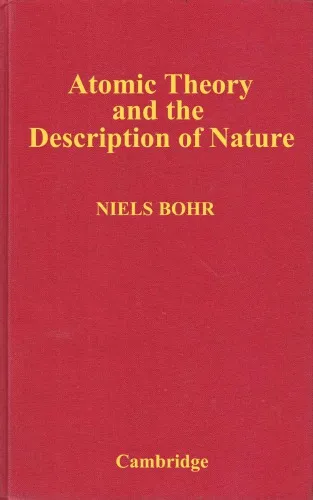
Introduction to "Atomic Theory and the Description of Nature" Written by the eminent physicist Niels Bohr, "Atomic Theory and the Description of Nature" stands as a monumental work in the understanding of quantum theory and the philosophy of science. It presents a detail
Before you read
Written by the eminent physicist Niels Bohr, "Atomic Theory and the Description of Nature" stands as a monumental work in the understanding of quantum theory and the philosophy of science. It presents a detailed exposition of Bohr’s pioneering ideas and reflects on the profound implications of atomic theory on various aspects of human thought and scientific philosophy.
In this book, Bohr delves into the complementary principles of quantum mechanics, arguing for the necessity of considering both wave and particle dualities when describing atomic phenomena. It is not only a technical treatise on physics but also an exploration of the nature of knowledge and the epistemological shifts that the new science demanded.
The integration of scientific exploration with philosophical reflection makes this book an enduring classic, relevant to physicists, philosophers, and historians of science alike. By connecting abstract physical theories to broader philosophical questions, Bohr bridges the gap between empirical science and human understanding in a way that remains deeply inspiring today.
The book is a collection of essays and lectures written by Niels Bohr during the 1910s to 1930s. These pieces explore the revolutionary ideas of quantum mechanics and how they reshape our understanding of reality.
Bohr begins by emphasizing the limitations of classical physics in explaining atomic systems. He introduces the concept of complementarity—a cornerstone of his thinking—wherein seemingly contradictory properties, like the wave-particle duality of light, are both necessary for a complete description of nature. This concept challenges the notion of determinism and invites readers to rethink causality and observation in the scientific method.
A significant portion of the book discusses the role of observation in quantum mechanics, emphasizing that the act of measuring influences the behavior of particles. Bohr’s interpretation laid the foundation for what is now called the "Copenhagen interpretation" of quantum mechanics. He weaves together physics and epistemology, illustrating how scientific inquiry is tied to humanity’s conceptual frameworks.
Moreover, Bohr acknowledges the broader implications of atomic theory on philosophy, art, and even language. By highlighting how language struggles to capture quantum phenomena, he calls for humility in scientific pursuits and reinforces the idea that science is a human endeavor, marked by its limitations as much as its successes.
"The task of science is both to extend the range of our experience and to reduce it to order."
"Every word or concept, clear as it may seem to be, has only a limited range of applicability."
"It is the hallmark of any deep truth that its negation is also a profound truth."
"Atomic Theory and the Description of Nature" is not just a book about physics; it is a profound exploration of epistemology, or the theory of knowledge. It portrays science as an evolving discipline, influenced as much by philosophical thought as by empirical discoveries.
The insights provided in this book are crucial for understanding the quantum revolution, which disrupted centuries of classical, deterministic thinking. By introducing the concept of complementarity, Bohr provided a framework for reconciling the paradoxical nature of quantum phenomena.
Furthermore, the book is an invitation to humility and open-mindedness. It reminds us that scientific theories are human constructs, limited by language and observation. For anyone interested in the philosophy of science, history of quantum mechanics, or simply the nature of reality itself, Bohr’s work is an essential cornerstone.
Even today, Bohr's ideas remain relevant, as quantum mechanics continues to serve as a foundation for cutting-edge research in physics, technology, and beyond. "Atomic Theory and the Description of Nature" is, therefore, a timeless text—a bridge between past discoveries and future innovations.
Your question is answered in the context of this title and author. Each answer uses 2 points.
0 reviews, 4.4 average out of 5
Sign in to publish a review.
Ask a focused question and learn from the community.
Related references that continue this learning path.
Richard P. Feynman,Robert B. Leighton,Matthew Sands

Richard P. Feynman,Robert B. Leighton,Matthew Sands