
Lilliixxx iApplæ Træa
2025/01/08
5 / 5
Excellent book, convenient to read, great lecture
Book guide and evaluation
Gideon Freudenthal (auth.)
1 reviews
Published
pages
views
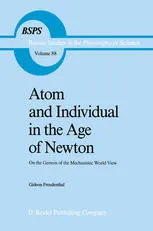
Introduction to "Atom and Individual in the Age of Newton: On the Genesis of the Mechanistic World View" Written by Gideon Freudenthal, "Atom and Individual in the Age of Newton" is a profound philosophical and historical exploration of the emergence and consolidation of the m
Before you read
Written by Gideon Freudenthal, "Atom and Individual in the Age of Newton" is a profound philosophical and historical exploration of the emergence and consolidation of the mechanistic worldview in the context of early modern science. The book delves into a pivotal moment in human thought, where the intellectual foundations of modern science—especially physics and its mechanistic principles—were laid. It links these developments to broader philosophical ideas about individuality, agency, and the structure of society.
The mechanistic worldview, as popularized by figures such as Isaac Newton, was characterized by an understanding of nature as a vast, orderly machine operating according to universal laws. This revolutionary shift in perspective intersected with changes in philosophy, religion, and social thought, sparking powerful debates about determinism, free will, and individualism. Freudenthal meticulously investigates these intersections, situating the atomistic and mechanistic ideas within their historical and intellectual milieu. The result is a rich, interdisciplinary narrative that illuminates not only the genesis of the mechanistic worldview, but also its broader implications for how we understand both nature and ourselves.
The book is structured to guide the reader through the historical development of mechanistic thought, beginning with its philosophical and scientific roots in the ancient world, progressing through the Renaissance, and culminating in the Newtonian synthesis during the seventeenth century. Freudenthal focuses on how the adoption of atomism and mechanistic theories reshaped scientific investigation and influenced broader societal views on individuality and order.
In early sections, the author traces the revival of atomistic philosophy in the Renaissance and its reception by key figures such as Descartes and Boyle. These thinkers helped lay the groundwork for a mechanistic interpretation of nature by rejecting Aristotelian teleology and embracing explanations based on particles and motion. Freudenthal emphasizes how this transition was not merely scientific but deeply philosophical, reflecting shifts in how individuals related to nature and each other.
As the book progresses, its attention turns to Isaac Newton and his monumental contributions to physics, particularly the formulation of universal gravitation and the laws of motion. Freudenthal elucidates how Newton's ideas exemplified the mechanistic worldview and firmly established it as the dominant paradigm of the time. However, the book also critically examines the contradictions and tensions that emerged within this framework, such as debates about the role of God in sustaining the cosmic order and the philosophical implications of determinism.
In later chapters, Freudenthal explores how the mechanistic worldview influenced ideas about human individuality in the context of Enlightenment thought. By drawing analogies between atoms in motion and human beings as autonomous actors, thinkers of this period came to new conclusions about society, morality, and political organization. The book concludes by reflecting on the enduring legacy of this synthesis and its implications for our current understanding of science, nature, and human agency.
"The mechanistic worldview is not merely a picture of nature but a mirror in which humanity has sought to discern its own reflection."
"Newton’s cosmos, ordered by natural laws yet sustained by divine will, encapsulates the paradoxes of a worldview that is both deeply deterministic and profoundly theological."
"Atoms in motion are not just physical entities; they are symbols of individuality, freedom, and the pursuit of knowledge."
"Atom and Individual in the Age of Newton" is an essential read for those interested in the history and philosophy of science. By exploring the emergence of the mechanistic worldview, the book provides invaluable insights into the intellectual transformations that gave rise to modern science and shaped contemporary thought. Freudenthal masterfully bridges disciplines, showing how scientific ideas are inextricably linked to broader cultural and philosophical currents.
For scholars, researchers, and curious readers alike, this book offers a rich, thought-provoking narrative that illuminates not only the past but also the enduring relevance of these ideas in the present. By understanding the origins of the mechanistic worldview, we gain deeper insight into the philosophical assumptions underpinning modern science and technology, and we better appreciate the complexities and contradictions of our own age.
Your question is answered in the context of this title and author. Each answer uses 2 points.
1 reviews, 5.0 average out of 5
2025/01/08
5 / 5
Excellent book, convenient to read, great lecture
Sign in to publish a review.
Ask a focused question and learn from the community.
Related references that continue this learning path.

Krzysztof Burdzy
Immanuel Kant,James W. Ellington