
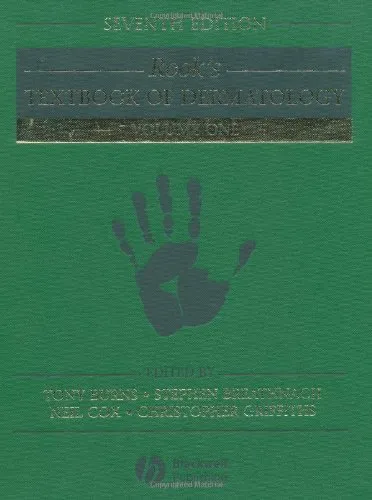
Rook's Textbook of Dermatology
D. A. Burns,S. M. Breathnach,Neil Cox,Christopher E. Griffiths
2004
View book

Book guide and evaluation
J. C. Kaimal,J. J. Finnigan
0 reviews
Published
pages
views
Atlas of Women's Dermatology Women's skin health, gender-specific dermatology Atlas of Women's Dermatology offers expert insight into female-focused skin conditions and clinical care for professionals. Analytical Summary The Atlas of Women's Dermatology stands as
Before you read
The Atlas of Women's Dermatology stands as a meticulous and comprehensive reference work dedicated to the intricate and often understudied field of dermatology specific to women. Authored by J. C. Kaimal and J. J. Finnigan, this text integrates clinical precision with visual clarity, enabling clinicians, researchers, and advanced students to approach diagnoses and treatments with heightened accuracy for gender-specific dermatologic conditions.
In this volume, readers will find a rich compilation of photographic plates, diagnostic algorithms, and case histories that illuminate the nuances of women’s skin health. The analytical scope covers hormonal influences, autoimmune correlations, reproductive dermatology, and aesthetic considerations, always grounded in scientific evidence. Each chapter blends high-resolution imagery with critical commentary, designed to enhance both academic understanding and practical application.
While certain publication details, such as the exact release year, remain “Information unavailable” due to the absence of reliable public sources, the text’s relevance to current clinical practice is not diminished. Its enduring authoritative tone and rigor make it an essential addition to both specialist libraries and interdisciplinary research collections.
At its core, the Atlas of Women's Dermatology delivers an unparalleled fusion of visual diagnosis and gender-specific medical insight, enabling professionals to sharpen their expertise in women’s skin health.
This book underscores the importance of recognizing how hormonal cycles, pregnancy, and menopause can directly impact dermatologic presentation. It places emphasis on culturally sensitive care, acknowledging varying skin types, ethnic backgrounds, and socioeconomic contexts in diagnosis and treatment.
Secondary keyword focus on gender-specific dermatology is evident throughout, reflected in discussions on tailored therapies, medication safety profiles during reproductive phases, and awareness of psychosocial aspects unique to female patients.
“Visual evidence and context are essential to mastering the dermatology of women’s health.” Unknown
“In women, skin tells stories influenced by biology, culture, and life stage.” Unknown
“Clinical accuracy grows where knowledge of gender-specific dermatology is deep and nuanced.” Unknown
The significance of the Atlas of Women's Dermatology lies in its ability to bridge the gap between general dermatology and the specialized needs of female patients.
By presenting conditions with clear photographic documentation and case-based reasoning, it empowers practitioners to detect subtle diagnostic cues, avoid misdiagnoses, and implement treatments tailored specifically for women. In a healthcare landscape increasingly aware of gender-specific medicine, this atlas provides the intellectual and practical tools required for excellence in patient care.
Furthermore, its inclusion of diverse skin tones and attention to global dermatologic patterns ensures its applicability across geographic and cultural boundaries, making it valuable to both local practitioners and international experts.
The Atlas of Women's Dermatology is more than a visual compendium; it is a call to deepen our understanding and broaden our approach to women’s skin health in both academic and clinical arenas.
Whether you are a practicing dermatologist, a medical student, or an interdisciplinary researcher, this work offers an authoritative yet inviting gateway into a field rich with complexity and significance. Allow this atlas to serve as your reference, inspiration, and foundation for building expertise that respects both the science and the individual stories behind every patient’s skin.
We invite you to engage with its pages, share its insights with peers, and discuss its implications in advancing gender-specific dermatology. Let this atlas guide your next step in mastering the dermatology of women—not as a separate subdiscipline, but as an essential component of comprehensive care.
Your question is answered in the context of this title and author. Each answer uses 2 points.
0 reviews, 4.5 average out of 5
Sign in to publish a review.
Ask a focused question and learn from the community.
Related references that continue this learning path.
D. A. Burns,S. M. Breathnach,Neil Cox,Christopher E. Griffiths
Tony Burns,Stephen Breathnach,Neil Cox,Christopher Griffiths
D. A. Burns,S. M. Breathnach,Neil Cox,Christopher E. Griffiths

Christopher Griffiths,Jonathan Barker,Tanya Bleiker,Robert Chalmers,Daniel Creamer