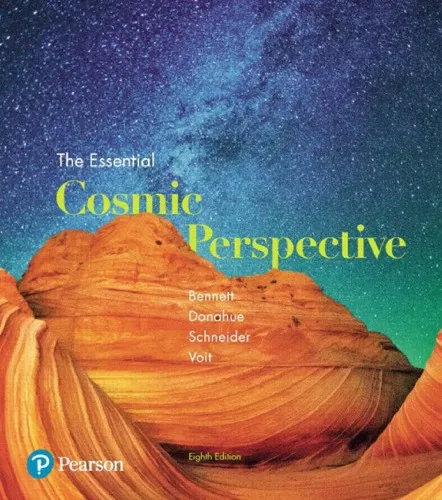
The Essential Cosmic Perspective (8th Edition)
Jeffrey O. Bennett,Megan O. Donahue,Nicholas Schneider,Mark Voit
2018
View book
Book guide and evaluation
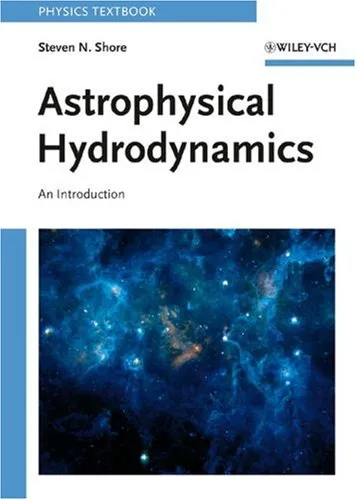
Steven N. Shore
0 reviews
Published
pages
views
Introduction to Astrophysical Hydrodynamics Astrophysical hydrodynamics forms the cornerstone of our understanding of celestial and cosmic phenomena. This book, Astrophysical Hydrodynamics, provides an in-depth exploration of the theoretical foundations and practical applicati
Before you read
Astrophysical hydrodynamics forms the cornerstone of our understanding of celestial and cosmic phenomena. This book, Astrophysical Hydrodynamics, provides an in-depth exploration of the theoretical foundations and practical applications of fluid dynamics in astrophysical settings. Aimed at students, researchers, and professionals in astrophysics, this work bridges the complexities of fluid motion with the large-scale structures we observe throughout the universe. This introduction offers an overview of what the book covers, the key lessons it provides, famous quotes to inspire your journey, and why it occupies a critical space in scientific literature.
The book begins with laying the groundwork for hydrodynamics principles, progressively building toward the unique challenges and scenarios encountered in an astrophysical context. The first chapters delve into fundamental equations of motion, the nuances of compressible and incompressible flows, and the effects of turbulence in the interstellar medium. Readers are then guided through the physics of shock waves and their pivotal role in star formation, supernova explosions, and galactic dynamics.
The later sections turn toward advanced topics such as magnetohydrodynamics (MHD), which describes the interaction between magnetic fields and conducting fluids such as plasmas. Applications to phenomena like solar winds, accretion disks around black holes, jets, and outflows are described in meticulous detail. Additionally, the book addresses radiative hydrodynamics, where the coupling between radiation and charged particles plays a significant role.
The book also emphasizes numerical methods essential for modeling astrophysical flows. These computational techniques, crucial to modern astrophysics, allow researchers to simulate environments that are otherwise impossible to replicate. By integrating theory, observations, and simulations, the book provides a comprehensive framework for understanding how hydrodynamic processes shape the universe.
"Fluid dynamics is not just the study of flowing matter; it is the language through which the universe speaks, from the ripples in interstellar gas to the roiling chaos of a supernova's heart."
"Understanding hydrodynamics is akin to deciphering the DNA of cosmic structures. Every galaxy, every star-forming region holds evidence of its influence."
Astrophysics is a field driven by questions as colossal as the universe itself. At its heart lies a need to understand the dynamics of matter as it flows, collides, and evolves under the immense forces of gravity, radiation, and magnetism. Astrophysical Hydrodynamics is a vital resource for anyone looking to probe these questions. It offers not only a practical toolkit for tackling real-world astrophysical problems but also reveals the elegance and interconnectedness of the physical laws that govern the cosmos.
By striking a balance between depth and accessibility, the book serves as an indispensable resource for both beginners and experts in the field. It also highlights the growing significance of computational astrophysics, empowering readers to bridge traditional approaches with modern simulation techniques. As astrophysical phenomena remain at the forefront of scientific curiosity, the insights and tools provided by this book are invaluable.
Ultimately, Astrophysical Hydrodynamics matters because it opens a door to understanding the complex, dynamic forces that have shaped the universe for billions of years, and that continue to do so. It is a book that informs, inspires, and challenges its readers to think expansively and critically about the cosmos.
Your question is answered in the context of this title and author. Each answer uses 2 points.
0 reviews, 4.5 average out of 5
Sign in to publish a review.
Ask a focused question and learn from the community.
Related references that continue this learning path.
Jeffrey O. Bennett,Megan O. Donahue,Nicholas Schneider,Mark Voit

David R. DeBoer (auth.),Domingos Barbosa,Sonia Anton,Leonid Gurvits,Dalmiro Maia (eds.)