
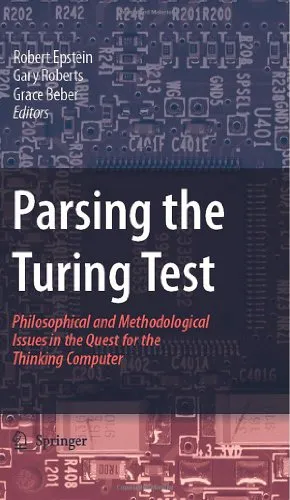
Parsing the Turing Test - Philosophical and Methodological Issues in the Quest for the Thinking Computer
Robert Epstein,Robert Epstein,Gary Roberts,Grace Beber
2008
View book
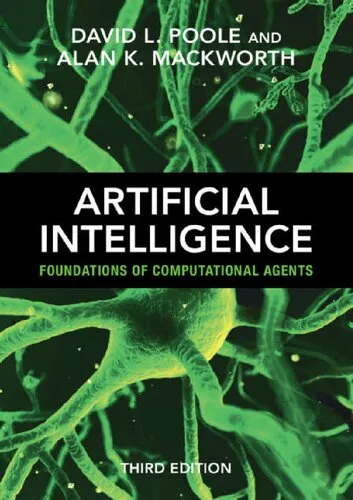
Book guide and evaluation
David L. Poole. Alan K. Mackworth
0 reviews
Published
pages
views
Introduction to "Artificial Intelligence: Foundations of Computational Agents, 3rd Edition" In the realm of science and technology, artificial intelligence (AI) stands as one of the pillars of modern innovation. "Artificial Intelligence: Foundations of Computational Agents" of
Before you read
In the realm of science and technology, artificial intelligence (AI) stands as one of the pillars of modern innovation. "Artificial Intelligence: Foundations of Computational Agents" offers a comprehensive dive into the complex yet fascinating world of AI. This third edition encapsulates the essence of the AI journey, providing rich insights into foundational principles and real-world applications.
Our book serves as a foundational text that caters to both emerging scholars and seasoned professionals interested in the development, design, and deployment of intelligent computational agents. Over its chapters, readers are introduced to a broad spectrum of AI concepts, from basic problem-solving strategies to the more nuanced elements of learning, perception, and interaction.
The initial chapters lay the groundwork, explaining what constitutes an intelligent agent and how agents perceive and act upon their environments. Then, the text delves into the core architectures and techniques that allow agents to plan, learn, and make decisions, all while drawing upon mathematical models and real-world examples to illustrate these concepts.
Each chapter builds upon the last, creating an intricate tapestry of knowledge that spans the rudimentary building blocks of AI to the frontier applications in robotics, natural language processing, and beyond. Notably, the text balances theoretical underpinnings with practical implementations, aligning computational theory with tangible outcomes. Problems and exercises accompanying each section encourage hands-on engagement and critical thinking.
"Intelligence is the computational part of the ability to achieve goals in the world."
"An agent is anything that can be viewed as perceiving its environment through sensors and acting upon that environment through actuators."
"The science of AI seeks not only to understand how agents operate but also to engineer new intelligent agents."
In a rapidly evolving technological landscape, understanding AI's foundations is crucial for anyone aspiring to contribute to or leverage artificial intelligence's capabilities. This book is not just about interpreting algorithms or models; it's about fostering a deep comprehension of how intelligent systems are constructed and how they can coexist with humans in diverse environments.
Moreover, given the increasing integration of AI across various industries, from healthcare to autonomous systems, having a solid grasp of the underlying principles equips individuals to innovate responsibly and ethically. This text provides readers with the tools to not only comprehend current technologies but also to anticipate future trends and challenges.
Whether you're a student stepping into the world of computer science, an engineer looking to layer AI capabilities into your work, or simply someone fascinated by intelligent systems, "Artificial Intelligence: Foundations of Computational Agents" serves as an invaluable resource. It lays the intellectual groundwork and inspires readers to think critically about the role of AI in the modern world.
Your question is answered in the context of this title and author. Each answer uses 2 points.
0 reviews, 4.5 average out of 5
Sign in to publish a review.
Ask a focused question and learn from the community.
Related references that continue this learning path.
Robert Epstein,Robert Epstein,Gary Roberts,Grace Beber
Prabhanjan Narayanachar Tattar

David L. Poole &Alan K. Mackworth