Book guide and evaluation
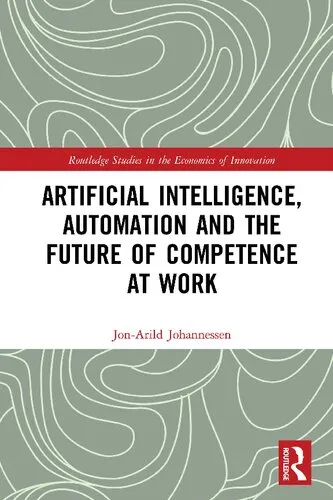
Artificial Intelligence, Automation and the Future of Competence at Work
Jon-Arild Johannessen
English
Unordered
Economics
4.4 / 5
0 reviews
2021
Published
171
pages
378
views
Artificial intelligence and the autonomous robots of the Fourth Industrial Revolution will render certain jobs and competences obsolete but will also create new roles, which in turn require new sets of skills. They will also transform how we produce, distribute and consume, as we
Before you read
What will you get from this book?
Artificial intelligence and the autonomous robots of the Fourth Industrial Revolution will render certain jobs and competences obsolete but will also create new roles, which in turn require new sets of skills. They will also transform how we produce, distribute and consume, as well as how we think. Rather than a linear understanding of evolutionary processes, we will develop a more interactive and circular interpretation. This book offers a unique and holistic perspective on the future of work in the context of industry 4.0. It discusses the globalization of capital markets, how artificial intelligence can help organizations to be more competitive and the new role of leadership in this technological landscape. The author argues that there are four categories of competences, which will be required in order to maintain the relevance of human skills and expertise in the innovation economy. The new jobs that come into being will lend themselves to a particular set of skills. General competences will be necessary for roles involving the 4Cs of communication, creativity, collaboration and change. Specific or STEM competences will be called for across the science, technology, engineering and mathematics sectors. Human competences will lend themselves to positions comprising the SELC framework of social, emotional, leadership and cultural skills. Critical or REVE competences will be in demand for roles embracing reflection, ethics, values and the environment. The book provides a human-centric view of the current technological advancements of artificial intelligence and robotics and offers a positive outlook for human actors seeking continued relevance. It will appeal to scholars and students of the innovation economy, the knowledge society and the coming Fourth Industrial Revolution.
Ask this book
Your question is answered in the context of this title and author. Each answer uses 2 points.
Sign in to ask the book assistant.
Reader reviews
0 reviews, 4.4 average out of 5
No reviews yet
If you have read this book, help the next reader with your experience.
Write a review
Sign in to publish a review.
Reader questions and answers
Ask a focused question and learn from the community.
Sign in to ask or answer a question.
No questions yet
Be the first to ask a clear, useful question.
What to read next
Related references that continue this learning path.
Solutions Architect's Handbook - Third Edition: Kick-start your career with architecture design principles, strategies, and generative AI techniques
Saurabh Shrivastava,Neelanjali Srivastav
2024
View book
Site Reliability Engineering: How Google Runs Production Systems
Betsy Beyer,Chris Jones,Jennifer Petoff,Niall Richard Murphy
2016
View book