Loading
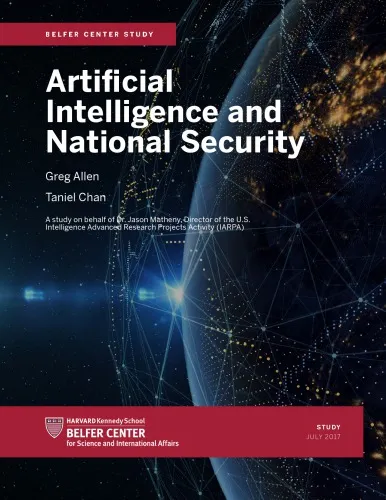
Cover of Artificial Intelligence and National Security

Book guide and evaluation

Artificial Intelligence and National Security

Greg Allen;Taniel Chan

English Beginner Artificial Intelligence (AI)
4.8 / 5

0 reviews

2017

Published

132

pages

390

views

Partially autonomous and intelligent systems have been used in military technology since at least the Second World War, but advances in machine learning and Arti cial Intelligence (AI) represent a turning point in the use of automation in warfare. ough the United States military

Before you read

What will you get from this book?

Partially autonomous and intelligent systems have been used in military technology since at least the Second World War, but advances in machine learning and Arti cial Intelligence (AI) represent a turning point in the use of automation in warfare. ough the United States military and intelligence communities are planning for expanded use of AI across their portfolios, many of the most transformative applications of AI have not yet been addressed. In this piece, we propose three goals for developing future policy on AI and national security: preserving U.S. technological leadership, supporting peaceful and commercial use, and mitigating catastrophic risk. By look- ing at four prior cases of transformative military technology—nuclear, aerospace, cyber, and biotech—we develop lessons learned and recommen- dations for national security policy toward AI.

Ask this book

Your question is answered in the context of this title and author. Each answer uses 2 points.

Sign in to ask the book assistant.

Reader reviews

0 reviews, 4.8 average out of 5

No reviews yet

If you have read this book, help the next reader with your experience.

Write a review

Sign in to publish a review.

Reader questions and answers

Ask a focused question and learn from the community.

Sign in to ask or answer a question.

No questions yet

Be the first to ask a clear, useful question.