
God, the Devil, and Darwin: A Critique of Intelligent Design Theory
Niall Shanks,Richard Dawkins
2004
View book
Book guide and evaluation
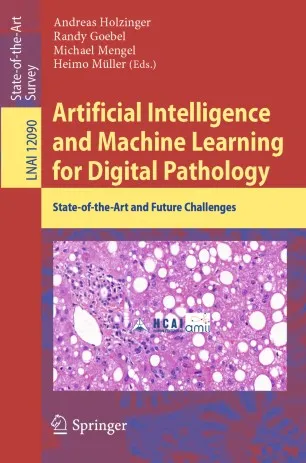
Andreas Holzinger,Randy Goebel,Michael Mengel,Heimo Müller
0 reviews
Published
pages
views
Welcome to the enlightening world of 'Artificial Intelligence and Machine Learning for Digital Pathology: State-of-the-Art and Future Challenges', a comprehensive exploration written by Andreas Holzinger, Randy Goebel, Michael Mengel, and Heimo Müller. This book is an in-de
Before you read
Welcome to the enlightening world of 'Artificial Intelligence and Machine Learning for Digital Pathology: State-of-the-Art and Future Challenges', a comprehensive exploration written by Andreas Holzinger, Randy Goebel, Michael Mengel, and Heimo Müller. This book is an in-depth guide that navigates through the complexities and nuances of incorporating artificial intelligence (AI) and machine learning (ML) into digital pathology, a field at the intersection of technology and medical science.
The book unravels the complex tapestry of AI and machine learning, charting their monumental impacts on the field of digital pathology. It starts by contextualizing the importance of digital transformation in pathology, emphasizing its contribution to more accurate diagnosis, prognosis, and treatment planning.
The authors delve into various algorithms and machine learning techniques employed in digital pathology, from traditional methods to advanced deep learning models. The text elucidates the operational mechanisms behind these technologies, examining how they enhance image analysis and diagnostic precision. Furthermore, the book ventures into discussing the role of AI in automating routine tasks and augmenting the pathologist's capabilities, helping to alleviate growing workloads in clinical settings.
A significant portion of the book is dedicated to real-world applications, showcasing practical examples and case studies where AI and ML have been implemented successfully. The authors also acknowledge current limitations and ethical challenges, exploring topics like data privacy, bias, and transparency. In closing, they provide a foresight into the future, predicting trends and technological advancements that could redefine the landscape of digital pathology.
“AI does not aim to replace the pathologist; it aims to empower them with tools and insights previously unimaginable.”
“In pathology, machine learning bridges the gap between innovation and clinical application, transforming raw data into life-saving interventions.”
'Artificial Intelligence and Machine Learning for Digital Pathology: State-of-the-Art and Future Challenges' is more than just a technical guide; it's a crucial resource for anyone involved in the medical, scientific, and technological fields seeking to understand the transformative power of AI and ML. The book addresses a significant knowledge gap by providing an accessible yet comprehensive analysis of cutting-edge technologies reshaping digital pathology.
This publication is vital because it brings to light the profound implications of AI technologies in medicine, encouraging a dialogue between technologists and healthcare professionals. It offers not only academic insights but also practical strategies for implementing AI-driven solutions in clinical settings, aiming to improve patient outcomes and make healthcare more efficient.
Moreover, the book’s emphasis on ethical and future challenges prepares stakeholders in the healthcare ecosystem for responsible AI adoption, ensuring technology serves humanity with integrity and respect for privacy.
Persian Summary
Your question is answered in the context of this title and author. Each answer uses 2 points.
0 reviews, 4.1 average out of 5
Sign in to publish a review.
Ask a focused question and learn from the community.
Related references that continue this learning path.
Niall Shanks,Richard Dawkins
D. Jason Slone;William W. McCorkle (editors)